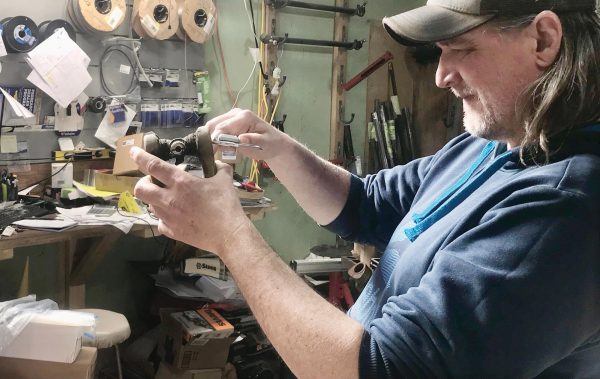
Robert Smith has spent his entire career in the farm machinery parts and service trade.
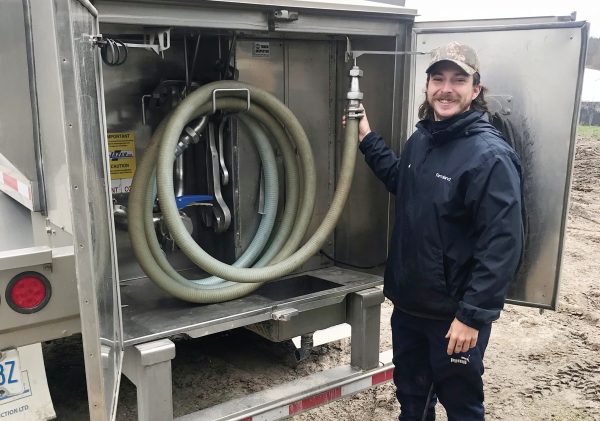
Jack Parleviet, aka Forest Gumption, enjoys the challenge of driving a milk truck and the free time it gives him to work on his rap music. (Charles Summers photos)
Ode to the Farm Team
These flourishing hard-working folk chart their own paths and serve the farm





 If an Ontario farmer is looking for a reference for how much the world has turned over the past couple hundred years, there’s no better reference than Farmer Boy.
You’re no doubt familiar with the Little House on the Prairie series of novels by Laura Ingalls, whether you watched it adapted to television or had it read to you in grade school. It documents the bold settlement of the American West through the lens of the author’s childhood, telling the story of millions of families’ domestication of the vast plains.
Farmer Boy is the second book in the series, and a departure from the theme and narrative of the chronology. Rather, it focuses on a year in the life of a nine-year-old farm boy in Upstate New York; Laura’s eventual husband, Almanzo Wilder. Set just across the river from Cornwall in Malone, New York, it details the day-to-day life (and mainly work!) of a prosperous 1860s farm. It’s a beautiful and detailed account of a moment in time in agriculture, as well as the culture and standards that went before us. What strikes me the most is the absolute self-reliance our predecessors possessed.
In the final scene of the novel, Almanzo, at all of nine, is being grilled by his parents about the opportunity to apprentice under a wheelwright in lieu of carrying on the farm. His father reminds the lad about the trade-offs of independence on a farm:
You’d have an easy life in some ways… but you have to depend on other folks in town son. Everything you’ve got, you’d get from other folks. A farmer depends on himself and the land and the weather. You raise what you eat, you raise what you wear, and you keep warm with the wood from your own timber. You work hard, but you work as you please, and no man can tell you to come or go.
What’s really amazing is that he’s not exaggerating at all. They grew nearly every bit of food they ate, they dressed themselves in the (no doubt very hot and itchy) clothes they sheared, carded, spun, wove, cut and sewed — from their own sheep. They raised their own tractors (horses and oxen) and fed them diesel (oats and hay) from their own land. And if they needed an implement, they didn’t call the banker or check out an online auction: They cut some leather, they cut some oak and hickory, and made the rest of what little they needed with the help of the village blacksmith.
The farmer of 2024 finds himself in a much different boat. Dependent on precarious markets, heavy financing, and an ever-growing list of inputs and expenses, the person crazy enough to farm today needs all the help they can get. We all see and celebrate things like the glory of harvest, good weather, and the odd stroke of luck, but farming is a hard and dirty business, and how the sausage actually gets made relies on people you don’t normally hear about. Abstract global supply chains now provide the raw materials and technology for modern farms, but flesh and blood people remain on the frontlines.
Robert Smith grew up on a dairy farm outside of Winchester. He always loved machinery, but working in the barn never suited him. At age 17, he took his first job at the counter of the local Deere dealer, and he’s been pretty well memorizing parts numbers and exploded 3D diagrams ever since. The new grandpa has been at it for over three decades now, and possesses an encyclopedic knowledge of countless manuals and catalogues; in all of the colours of the rainbow of agriculture and power equipment.
“I’m just good at remembering things. I’ve been around this stuff for a while now!”
I first encountered Robert at Clow’s Farm Equipment. More than once, I’d be struggling, trying to articulate what exactly I needed to get a repair done. “Yes, it’s under the seat, no, on the other side of the fuel line, no, the other side…”
I was struggling with an equally frustrated, but very patient gentleman at the counter. Rob (who took care of the garage’s parts needs) would be within earshot, and quickly, with a furrowed brow, would whisper the exact right parts number to his colleague.
But being good at his job wasn’t enough for Robert, so five years ago he went out on his own with RKS Parts: “I started working out of my car, first thing I sold was a set of excavator tracks.” He finds himself today in a modest shop on Highway 15 outside of Seeley’s Bay. I’m just around the corner, and I can’t tell you how many times Rob has stopped whatever he’s doing to get us going again as quickly as possible, whether putting zippers on belts, swapping PTO shafts, or dropping off hydraulic oil on his way by. This element of service has become increasingly important to Rob’s business: resealing cylinders and rebuilding gear boxes are popular services for busy farmers. “I don’t want to sound like a cornball, but I really do look at my customers as my friends.” And just as important as Rob’s relationships with his customers, he also relies on over 30 years of contacts and social capital in the far flung, complex world of parts to actually put something in your hand.
It’s a good thing Rob grew up on a dairy farm, because the long hours he finds himself working are far beyond what was asked of him at any dealership. The main problem I have with Rob’s business is that I often don’t always recall how vast his inventory actually is: everything from chainsaw bars to obscure hardware. I’ve made too many trips to Kingston when a text message to Rob would have sufficed. Whether you’re trying to save some money, or a trip to town, think of him before you go to the hardware store or parts desk.
As much as modern agriculture relies on equipment and technology, all of the production in the world is worthless without the transportation to get it to market. In the same way there’s no grind in farming like the calling to milk cows, the man behind the wheel of the milk tanker carries a similar cross. Jack Parleviet is 28 years old, been trucking for five years and is now looking in the rearview at his first year of dairy hauling.
Jack has a long circuit: an onerous route collecting from the widely dispersed and randomly arrayed network of organic dairy farms across Eastern Ontario. Needing to sleep a night in the sleeper, he leaves his family behind at their rustic, off-the-grid home in the highlands of Hastings County, north of Bancroft.
But he enjoys the hours in his cab. First of all, the challenge: “The cows don’t stop, and we don’t stop. No matter what the weather is, we’re moving. You need to be in control of your truck, and if there’s snow, if there’s mud, you keep going.”
He also appreciates seeing all of that beautiful countryside and the friends he makes at each of his stops. But easily the biggest perk of the job is the time and mental freedom to work on his personal passion: rap music. Yes, that’s right, the rapper who drives a milk truck. Jack has been obsessed with hip hop culture his entire life. His moniker in the world of rhymes is Forest Gumption — a name bestowed on him by his mother at age 12, when he was already deeply immersed in break dancing and working the microphone.
Forest doesn’t just sing to himself on the highway. He rocks bars in Canada’s largest cities, has a handful of albums and is all over social media. When my dairy farming friend Nigel told me that this far out dude who picks up his milk is a rapper, I didn’t really grasp that this far out dude isn’t some silly trucker with a crazy dream. There’s a certain charisma and brightness that very few people have, and despite the long hours on the clutch, carefully crafting clever layers of lyrics, the time on the road melts from Forest’s face: when all of sudden you find yourself in a milkhouse nightclub at 2 p.m., having fun, and genuinely, curiously entertained.
For Forest, the time on the road is a way to make ends meet. For Robert, his business is the greatest challenge of his life. We also all farm for different reasons too. Like agriculture, these professions take patience, endless hard work, and a great deal of gumption. Lest we forget that no man is an island: without guys like this, the industry does not work. And so, like agriculture, these professions only attract those with a generous serving of character; solid, funny people fully engaged with the journey of life.
Charles Summers owns Salt of the Earth Farm, a direct-to-consumer operation selling vegetables at the roadside, near Lyndhurst, Ontario.