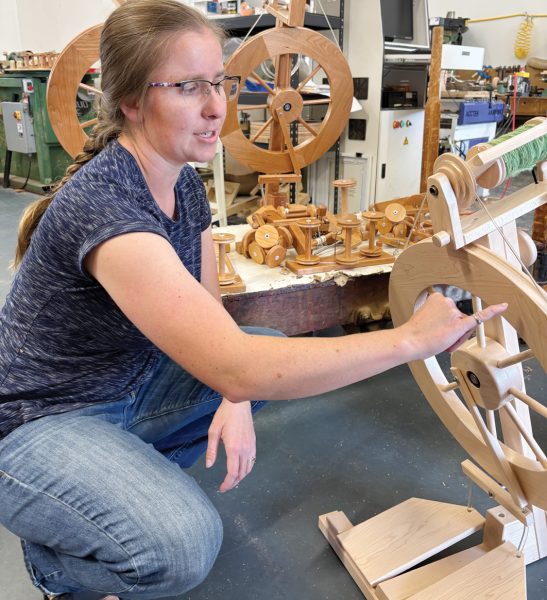
Morgan Nugent and her husband bought a spinning wheel-making operation and set up shop in the Carleton Place industrial park. (Charles Summers photo)
15,000 spinning wheels later
Medieval invention died out, then spawned a 21st Century venture
As much as agriculture — which was once a part of day-to-day life for nearly every average person — has been completely modernized into a specialized industry, so too has the creation of the clothes on our backs.
 Today, our costumes come across the Pacific from humming factories — but it was not many generations ago that the production of textiles was an ongoing routine in nearly every household.



In describing a virtuous woman, Solomon writes in the 31st Proverb: “She sees that her gain is good, and her lamp is not extinguished at night. She stretches out her hands to the distaff and grasps the spindle with her fingers. She opens her arms to the poor and reaches out her hands to the needy.” Before the industrialization of the textile industry, women were more or less expected to spend every spare minute, when they didn’t have their hands full, spinning yarn. Thus the epithet “Spinster” for the childless bachelorette.
It’s no wonder that spinning was a never-ending task when you begin to consider that a yard of cloth, at 25 threads per inch, takes over 1,800 yards of warp and weft to weave! Keeping a family clothed was a full-time job when there was nowhere to buy new duds. Although the distaff and spindle are a perennial technology, the innovation of the spinning wheel was embraced by any woman able to afford one.
Here in Canada, the historic production of spinning wheels was based in Quebec, where the settled Habitant culture placed an emphasis on home textile production. In the 19th and early 20th Century thousands of wheels were produced by artisans and workshops on the classic pattern known as the Canadian Production Wheel.
Like most of the changes of the 20th century, the World Wars and their push towards mass production very quickly made this cottage industry redundant. After churning out uniforms, tent canvas, and bandages, these machines produced fibre and cloth so efficiently that home production of fibre became obsolete.
But producing cloth by hand is far from dead. Spinning is an ancient art form, after all, and anything that has been practised so long by so many is very hard to extinguish. And so, the textile arts (despite their impractical nature) enjoy generational revivals and renaissances as new fingers feel the magic of the spindle and the loom. One such revival took place as part of the “Back to the Land” movement of the 70s, when the baby boomers sought to connect in a meaningful way with the basics of life.
Gord Lendrum was there for it. A mechanical engineering graduate from Peterborough, he was inspired by his mother’s enthusiasm for fabric to develop a practical and productive spinning wheel for the new crop of spinners. His design was a departure from the classic Canadian Production Wheel. It was sleek, compact and productive: and you can easily fold it up to store even in a tiny apartment. He sold his first six wheels in 1976 and it’s been a brisk business ever since.
50 years and 15,000 spinning wheels later things have once again come full circle in textile trends. The free-time generated by the Covid lockdowns inspired interest in hands-on things like sourdough bread and gardening: and spinning was no exception. So, with another revival on his hands, Gord decided to pass on the torch to a new generation of craftsmen.
Enter James and Morgan Nugent. Engineers by trade, these young parents purchased Lendrum’s business and set up shop in Carleton Place’s industrial park, a short bike ride from home. Almost a year into the venture, they’re thriving while their 13-month-old Henry plays in the wood shavings.
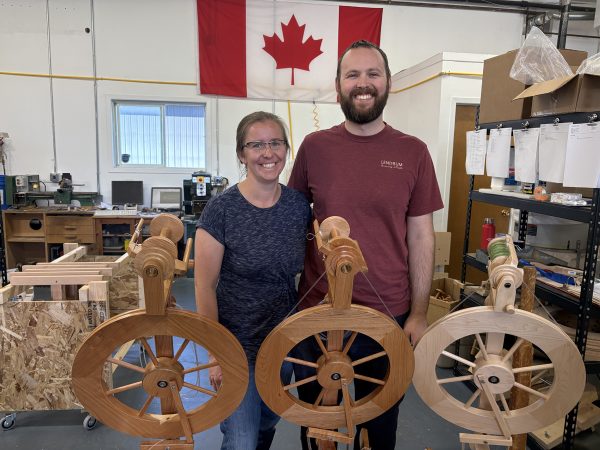
James and Morgan Nugent are spinning wheel makers and have carved out an impressive niche market. (Charles Summers photos)
Both James and Morgan have an affinity for older tools and devices: they use a typewriter for goodness sake! And their engineering minds lean into the precision of the instrument and the efficiency of manufacturing. It’s turned out to be a natural fit, as their fresh blood brings new energy to the business.
James’ enthusiasm shows as he rattles off the old-timey names of the parts of the wheel “this is the footman, these are the maidens, and this is the mother-of-all,” he grins as he showcases his deceptively simple looking machine. Their 2,500 sq. ft. shop is just big enough for their inventory of lumber and the various woodworking devices they purchased as part of the business from Gord. It looks straightforward enough, but there are over 200 individual components in a spinning wheel and they all must be made to very high tolerances.
Over the years, Gord cleverly frankensteined all kinds of different woodworking tools to meet his needs and adapted them to CNC programming. Today, James makes the components in large batches to facilitate ongoing production. It amazes me how little wood is wasted in their production. Many of the components are quite small, so each off-cut becomes the raw material for the next smallest item.
Lendrum wheels were traditionally made with hard maple: a durable and stable wood that works and wears well. To celebrate the business’ 50th anniversary, however, they’re making a special edition out of black cherry. It’s as beautiful as it is functional.
With an engineer’s mind and a craftsman’s heart, James is at home in the workshop and relishes the newfound independence of being a small business owner.
“It’s definitely a big step up from troubleshooting electrical problems for a corporate client.”
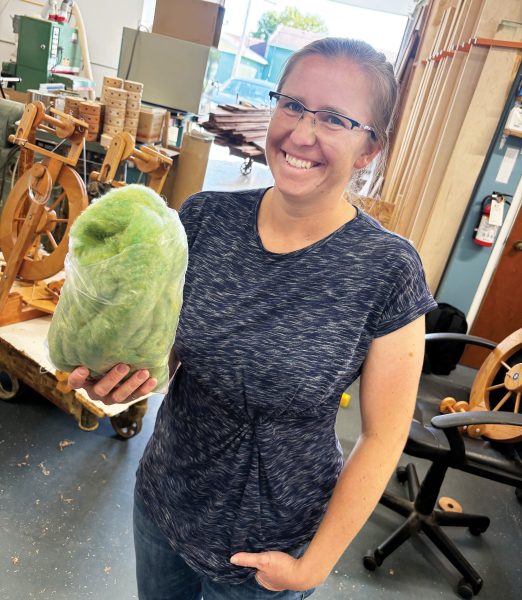
Spinning yarn to make clothes can be a full-time family job and buying a spinning wheel can cost $1,800. Yet, sales are good. (Charles Summers photo)
And while the work seems humble enough, there’s tremendous potential. The Nugent’s now have dealers across Canada, in seven U.S. states, not to mention Britain, Switzerland and Germany. They’re active on social media and you can even order direct from them online at their website www.lendrumwheels.ca
My mother was one of those baby boomers who got hooked on textiles back in the 70s, and I was fortunate to grow up in a house full of her beautiful handiwork. Back when she was learning to spin, she was proud to show off her archaic spinning wheel to my Opa. He sat down at the wheel and asked her to give him some fleece: she thought she was going to be in for quite the laugh.
He surprised her by being remarkably deft, thumping away on the treadle, rapidly producing perfect yarn. She was stunned as he whizzed away. Before long, he broke out in a cold sweat and stood up from the wheel. “That’s enough. Too many bad memories.”
Opa had spent every waking hour of the Nazi occupation working his tail off to put bread on the table. Spinning was a part of that hustle, and — though he was good at it — was something he did not want to revisit.
The beautiful fabric of life! We are all connected, like plies of yarn that work together to knit up a sweater. Where one of us ends, another one of us starts, and the yarn just keeps spinning. Whether we are spinning to survive, or spinning for the pleasure and wonder of it, these elements of life are with us always (unless you want to wander around naked, I suppose).
Seeing a young family like the Nugent’s put all of their chips on the table and boldly strike off in a new direction is so inspiring to me: especially when you consider how their work facilitates others’ work and the tactile experience of the end user. Their wheels will spin yarns and thread which will go on to be knit or woven and worn. And then a real live human like you and me are going to wear them, and that Lendrum spinning wheel is going to be right there as that fabric swishes around our body on this wonderful, beautiful, and terrifying walk of life.
Charles Summers owns Salt of the Earth Farm, a direct-to-consumer operation selling vegetables at the roadside, near Lyndhurst, Ontario.