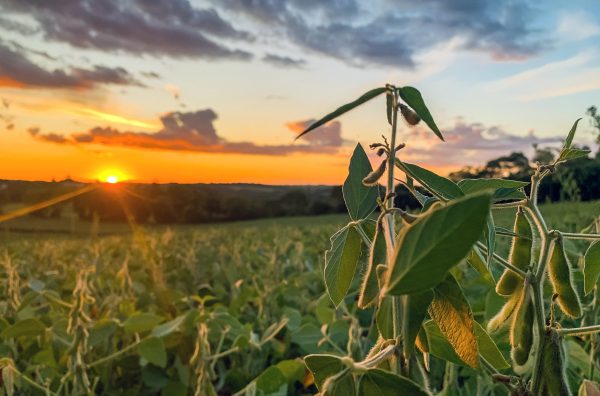
Dusk landscape with close-up of a soybean plant
OPINION: Super El Nino anxiety pushes up grain prices
But real weather impact will have final say
I really don’t trust weather forecasts. After having spent the first 45 years of my life in the beef business, I have enough experience trying to make dry hay to know that you can’t rely on the five-day forecast.
 While I am sure that there are a lot of other farmers out there who are not any more convinced than I am about the accuracy of the weather forecast, North American grain farmers have been having quite a summer enjoying the weather forecast pushing prices and profits to unexpected levels.
The “elephant in the room” for the commodity markets throughout the summer of 2026 is the Super El Nino setting up in the Pacific Ocean. An El Nino weather pattern is the result of warmer surface temperatures in the central and eastern part of the Pacific Ocean and it results in a weakening of the trade winds which changes global weather patterns. An El Nino is not an uncommon occurrence. Every year is either hotter than average, (El Nino), or cooler than average, (La Nina). What seems to have everyone’s attention is that the extent of the warming in the Pacific in 2026 is significant enough to have earned it the title of a “Super El Nino,” which means that surface temperatures in the central Pacific are at least 2 degrees warmer than normal. This anomaly has meteorologists busy trying to model out the potential impact these changes might have on crop production in the months ahead.
An El Nino weather pattern typically causes hotter and dryer growing conditions in northern and central regions of Brazil. The extended heat stress and drought is harmful to soybean yields and this part of Brazil is the heart of the soybean-producing area in the world’s largest producer of this crop. A reduction in South American soybean yields however is not a certain outcome as a result of an El Nino weather cycle.





While it seems likely that northern and central Brazil will have a hotter and dryer growing season, southern Brazil and northern Argentina might actually have more than normal rainfall and improved crop potential. What is very certain from the market’s current behavior is that global soybean demand is very strong, ending stocks are tightening, and therefore any perceived threat to supply has an immediate impact on values.
At the end of July 2025, Chicago soybean futures were trading around U.S. $9.75 per bushel. At the end of July 2026, soybean futures were flirting with U.S. $12.50. Cash prices for Ontario soybean producers have rallied from U.S. sub-$13 last summer to U.S. mid- $16 this summer for harvest deliveries into country elevator locations. There are a lot of factors helping to support higher soybean values. Some of these factors are a strong bio-fuel market, a burst of export demand from China, and our own North American summer time weather worries. But the floor support holding the entire soybean market up is that we have such strong demand that any sort of reduction in Brazilian crop size in their upcoming crop year could precariously tighten global ending stocks.
South America is not the only important agricultural region in the world which is negatively impacted by a Super El Nino. Australian wheat production is at risk. In anticipation of the 2026-2027 growing season, climatologists have already modelled weather patterns which could reduce Australia’s wheat crop to 26.7 million metric tonnes, which is a 20 % decline from their 2025-2026 production. Ontario’s entire wheat crop is about 2.5 million metric tonnes per year, so Australia is looking at a potential crop reduction the size of three year’s worth of our provincial output.
The headline news around wheat in 2026 has been full of worrisome issues. Drought in the U.S. south west damaged wheat yields in their hard red winter wheat belt. Heat stress across Europe may have cut yield potential in some growing regions. The continuing, and perhaps escalating war between Ukraine and Russia makes it challenging to export wheat out of the Black Sea region, so even the potential of a weather event that could cut Australian wheat yields significantly fuels the interest in buying wheat now.
The reality of the situation is that the grain and oilseeds markets don’t really trade the weather forecast as much as they rise and fall based on the anxiety which the forecast creates amongst traders in the market. Nobody appears to be waiting for the Super El Nino to develop and cause harm to southern hemisphere crops before they push prices higher, but rather prices have already firmed substantially, fueled by the concern over what might potentially develop.
It is even possible that if the southern hemisphere has a very mild El Nino impact on crop progress through November, December, and January, we could see grain markets fall because the real impact of the weather event didn’t live up to the worry about the potential problems that were forecast this summer. It feels like a sell-the-rumor, buy-the-fact market.
Steve Kell is a Simcoe County crop farmer and handles grain merchandizing for Kell Grain, with elevators in Belleville and Gilford.