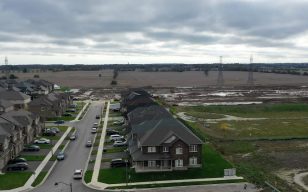
About 80 people attended a meeting in Morewood on Nov. 10 to discuss a large battery storage system that could be erected in nearby Marionville, north of Winchester.
Nelson Zandbergen
Farmers Forum
DUNDAS COUNTY — Proposals for multi-million-dollar battery energy storage projects are popping up around Eastern Ontario farm country and generating controversy and local opposition — with echoes of the solar- and wind-project gold rush funded by hydro ratepayers during the McGuinty-Wynne years.
South of Ottawa, the developers of a proposed 75-megawatt battery farm near the village of Marionville, fielded a slew of testy queries during a lengthy public meeting on the project.
Over more than two hours, the crowd of 80 people peppered the proponents with concerns about the potential for battery fires at the five-acre site, reduced property values, sound emissions, off-gassing and community benefit. The local township council of North Dundas later deferred a decision on whether to officially support or oppose the project, which would be located on land leased from a farmer at an undisclosed rate. Developer Baseload Power Corp. of Toronto will require council’s blessing to be eligible for a contract from Ontario’s Independent Electricity System Operator (IESO). The project would tie into an existing high-voltage transmission line already traversing the property.
Baseload Power president Jonathan Sandler told the local council that the project would pay the municipality $100,000 per year for 20 years.


Wind Concerns Ontario, an organization initially formed to fight wind projects, has counted 24 proposed battery energy projects in the province. The Ford government has instructed the hydro grid overseer — the IESO — to procure as much as 4,000 megawatts of new power capacity by 2028 as a result of the Pickering nuclear plant going offline. That includes a mandate for 2,500 megawatts of “clean” power, with much of that being battery storage. The IESO has set a Dec. 12, 2023, deadline to receive project proposals with attached motions of approval from local townships. In Eastern Ontario alone, a number of companies are planning submissions. There are proposals in Metcalfe, Fitzroy Harbour, North Glengarry, Napanee — plus two in South Dundas. The latter township council also put off decisions on whether to support those projects.
To the layman, a battery farm looks like a collection of shipping containers arranged on a gravel base and surrounded by a fence. The containers are loaded with lithium-based batteries that charge up at night when demand on the grid is low, soaking up some of the surplus power that is otherwise exported at a loss to Quebec and New York. When demand for power in Ontario is high, the IESO can draw electricity from the batteries to help make up the shortfall.
In the case of the Marionville proposal, the batteries would fit into about 50 containers and together be capable of supplying 75-megawatts of electricity for up to four hours. It would not function as an emergency power supply for local residents in the event of a blackout. The project’s outflow of 75 megawatts is equivalent to 7 % of the Cornwall hydroelectric dam’s output capacity. A Tesla car stores about one tenth of one megawatt of electricity (or 100 kilowatts) when fully charged.
Battery storage advocates say that recovering and storing surplus electricity is cheaper than building new gas plants. But battery projects aren’t cheap, either. A recently approved 250-megawatt project in Haldimand County — the biggest of its kind in Canada and with a similar four-hour running time — has a reported price tag of $800 million, or $3.2 million per installed megawatt. Other sources suggest substantially lower prices are now possible, but still in the multi-millions.
Sandler declined to offer a cost estimate for his proposed Marionville project but told Farmers Forum it was “very expensive” and that financial payback for his company would take “way more than five years.”
North Dundas deputy mayor Theresa Bergeron expressed skepticism at relying on lithium batteries to power the grid because of the environmental impact of mining the substance in ever-increasing amounts. “I think all levels of government have this battery-power tunnel vision,” Bergeron, a South Mountain-area goat farmer, said.