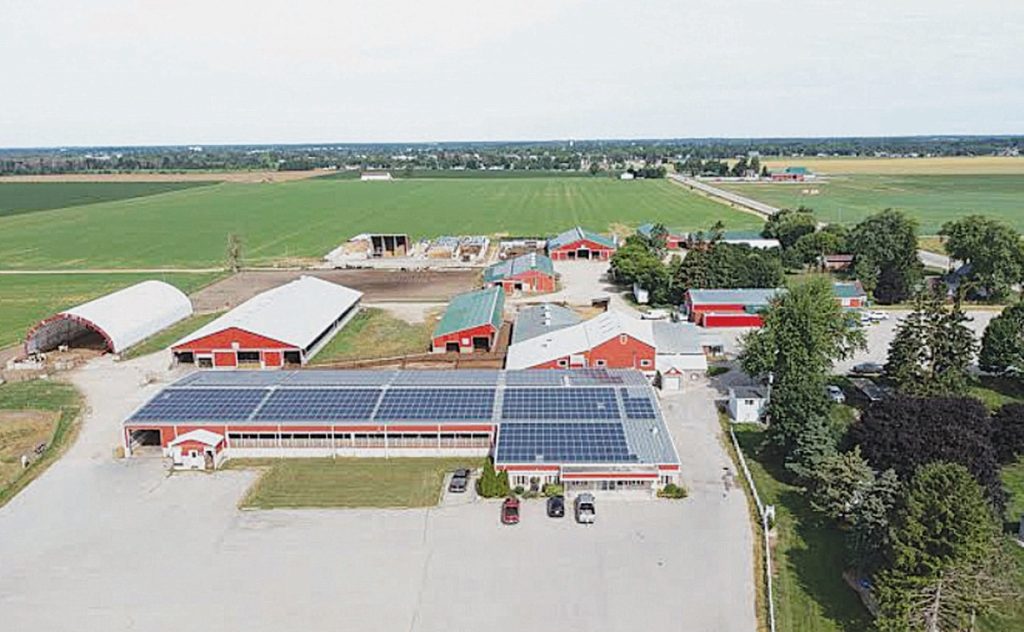
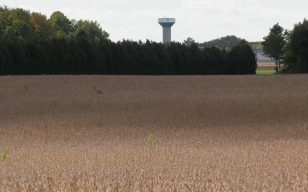
Auctioneer David Carson with his wife and business partner Margo. The Carson sale barn, above, at Listowel, with a 20,000 sq. ft. sale barn, was sold to Robert Van Nes of Evergreen Holsteins.
Nelson Zandbergen
Farmers Forum
LISTOWEL — In 2003, the BSE crisis hit David Carson’s dairy farm like a sledgehammer, forcing him to sell off a good chunk of his quota and drastically downsize his 125-head milking herd to just 30 Holsteins to stay afloat. The long-time farmer and auctioneer was majorly invested in raising dairy heifer calves for export when international markets closed overnight to Canadian cattle.
Suddenly, the 3,250 heifers being fed and raised on Carson’s behalf at several farms collapsed from a value $2,500 each to just $200 each. He was out $5 million.
“It got pretty tight,” admitted Carson, 79, who retired last month from a 60-year career milking cows and running a respected Listowel-area sale barn.
He recalled a meeting with bankers, lawyers and Farm Credit in Toronto, which laid bare the personal toll of the crisis that he counts as the biggest challenge of his career. “My accountant said to me on the drive home, ‘There was one man in that room who didn’t know you were broke — you,’” he remembered with a wry chuckle.





Ultimately, he credits the federal CAIS program as key to his financial survival, and he was able to gradually rebuild his dairy operation back up to its previous level. “We were very fortunate. The CAIS program saved my neck,” he said.
But the grandfather of six and great-grandfather of seven stepped away from it all last month, quipping that he had originally planned to retire at 50. It was barely a week after milking his last cows and only a couple of days after a final auction sale to disperse his remaining heifers, when Carson spoke with Farmers Forum. “I’m just ready now and I’m getting on in age,” he said, reflecting on a storied career marked by hard work, community trust, and resilience in tough times.
After 60 years in the business, Carson sold the farming operation to Robert Van Nes, of Evergreen Holsteins, who bought the 143-acres, the milk production quota, the 20,000 sq. ft auction barn, egg-grading station and other barns. The sale barn has ceased operations.
Carson’s journey began at age 19, when he bought his Listowel farm for $25,000 with help from his father, who held the deed until the young man became of age at 21. Growing up on a dairy and beef operation where his father also sold International Harvester equipment, Carson was no stranger to hard work. By 1968, he’d honed his auctioneering skills at a school in Mason City, Iowa, after cutting his teeth as a ring man for local auctioneers. “I always hung around auction sales,” he said. “A couple older fellas coached me, taught me how to go.”
His auction barn, built almost entirely by his own hands, became a hub for quality livestock, known for dairy herd dispersals, bred beef cows, and stocker sales. Carson’s commitment to fairness — to both sellers and buyers — defined his reputation. “You had to make sure you did a very good job for people,” he said, recalling sales where he handled the livelihoods of both fathers and sons in a single day. “You didn’t sell a pig in a bag. You had to treat buyers right, keep customers coming back.”
He also auctioned off machinery at regular consignment sales at his own property, and travelled to farms around the region to perform the task. His vocation took him all over the country and down into Florida as well.
He summed up his auctioneering technique: “You have to be very plain. The people have to understand you, and you have to know your numbers very well. I was always really good at oral arithmetic.”
He counted his employees as the backbone of his success. “I had terrific staff,” he emphasized. “One guy was here 49 years before he passed. A couple others were over 40 years.”
David Carson Farms & Auction Services weathered other changes, from skyrocketing interest rates in the 1980s to the challenges of the COVID-19 pandemic. His perch as auctioneer gave Carson a firsthand look at the impact of that brutal recession of the early 1980s. “Through the 1970s, every sale you had you were a hero because everything was selling so good. Then, when interest rates got high and things got tough …I had a few sales where we had to sell the people out to the bank.”
During the pandemic, the business embraced online live streaming, which continued as a side feature of most sales, though Carson prefers the in-person experience of attending a sale.
His final sale was a high note, with cattle fetching exceptional prices, including three heifer calves sold multiple times for charity, raising $33,000 for a new Agricultural Science Centre in Listowel, a local hospice, and 4-H clubs.
Though he’s sold his dairy herd, Carson isn’t stepping away from the farm. He’ll continue cash-cropping 350 acres and dabbling in horses, including a pair that he races at the Mohawk and London tracks. A 2015 World Clydesdale Show championship remains a proud memory. On June 13, 2025, he and his wife, Margo, who worked tirelessly alongside him handling advertising and phone calls, will host a customer appreciation day from 1 to 5 p.m. “People have been really good to me. I want a chance to talk, not be rushed like at a sale,” he said.
“I’ve met a lot of good people, had a lot of fun,” he said.
He admitted to feeling a mix of emotions seeing the last of cattle trucked off the farm, noting that it’s really the first time since age 12 that he hasn’t owned bovine livestock.