Dairy farm not guilty but gets fined anyway
Farm fined $1,649 for antibiotic in milk that tribunal agrees was not used by farmer
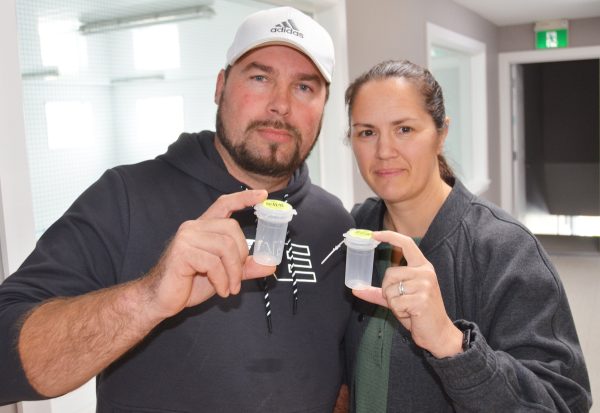
Dairy farmers Josh and Ellen Biemond
Nelson Zandbergen
Farmers Forum
SOUTH DUNDAS — Iroquois organic dairy farmers Josh and Ellen Biemond are pushing for regulatory reform of Ontario’s milk-testing regime after a provincial tribunal recently agreed that the Biemonds don’t use antibiotics on their farm but nonetheless upheld a penalty against them for a single milk sample that tested positive last year.
“Mr. Biemond testified that he does not use antibiotics on the farm and that there is no way that the sample could have tested positive for amphenicols,” the three-person panel at the Agriculture, Food and Rural Affairs Appeal Tribunal wrote in their June 30 decision. “We accept that evidence. That does not, however, mean that the positive test is not reliable.”
“How can those two things be said in the same sentence?” a frustrated Josh Biemond exclaimed in a July 20 interview with Farmers Forum.





For the Biemonds, it was never about the $1,649 penalty imposed by the Dairy Farmers of Ontario. They were driven to defend their farm’s integrity and honour as an organic operation of over 30 years. But Biemond said they are “done” fighting and won’t pursue a judicial review. They are instead lobbying for regulatory change at the political level.
The couple insists they were victims of a rare false positive when the regular milk sample from their bulk milk pickup on Oct. 1, 2025, tested positive for the “amphenicol” class of antibiotics, a drug not popularly used to treat production-age cattle, even on conventional dairy farms.
A second test of the same sample a few days later came back negative but wasn’t officially accepted because that sample had been frozen after the initial positive result.
A sample from the farm’s next load of milk, picked up on Oct. 3, also tested negative. And in an unusual twist, because the Biemonds process all of their own milk on the farm as ‘Upper Canada Creamery,’ the Canadian Food Inspection Agency got involved and tested the end product sold to consumers from the Oct. 1 batch. CFIA located only two remaining cartons on a grocery store shelf. A test from one of the cartons also came back negative. (The October 1 load was already processed and almost sold out by the time the couple learned of the positive amphenicol test. DFO picks up the Biemonds’ milk like any other farm but delivers it straight to their processing plant a stone’s throw from the barn.)
As it turns out, while the samples collected with every load of milk from Ontario’s 3,100 dairy farms are tested for penicillin and a number of other antibiotics, only four samples in the province are tested for amphenicols at any given time. That gap is among the issues spotlighted by the Biemonds.
The couple, who represented themselves at the hearing, are also pushing for an alignment of federal and provincial antibiotic testing standards. They have discovered that DFO and OMAFA don’t accept CFIA lab results performed outside of the University of Guelph.
“It’s pretty simple: Approve higher-level testing (at the provincial level) and approve more labs so that farmers have somewhere else to go for a second opinion,” Ellen Biemond said.
They say the limited provincial test provided no data to them on the involved type of amphenicol (out of three potential types) and the quantity allegedly found in the sample. “So we couldn’t even argue sabotage or anything like that because we don’t have any numbers,” Josh Biemond said.
While the couple don’t believe they were actually sabotaged, they strongly suspect the positive test happened as a result of inadvertent technician contamination at the University of Guelph lab that exclusively conducts the milk tests for the Ministry of Agriculture,
Food and Agribusiness and DFO. But the current testing used also “doesn’t rule out natural interference in the milk that mimics the reaction the test is designed to look for,” Ellen Biemond said.
They requested that the involved technician appear at the tribunal to answer their questions, only to discover that the lab’s director of the operations was swapped in as a witness at the last minute. They had wanted to ask the actual lab tech about possibly having a pet under his or her veterinary care or perhaps somebody in the family being treated for pink-eye. “That might have been enough” to contaminate the sample, Josh Biemond speculated.
The eye-opening experience has soured them on the Ontario dairy industry.
Biemond says they do “not want to be a part of it because it doesn’t protect the farmer. It doesn’t protect the consumer.”