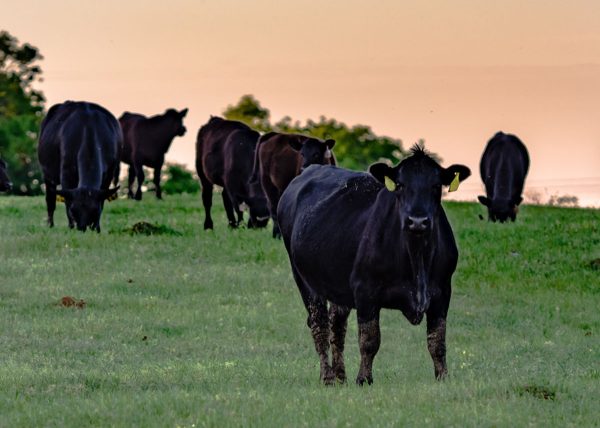
BRUSSELS, ON — Rain makes the grass grow. So maybe that’s why light showers didn’t discourage well over 300 graziers from attending a Pasture Walk and Talk, including a beef barbeque, near Brussels on June 4th. Tim and Donna Prior, owners of feed and farm supplies outlet, Brussels Agri Services, invited their customers to their farm for the popular event, which has been held for nearly 20 years..
 Bryan Sanderson, Beef Business Manager for livestock nutrition company Alltech, was the keynote speaker and addressed “The Real Truth About Cows and Carbon.” His presentation touched on the science, environmental impact, and politics involved in pasturing cattle. Sanderson directed the audience’s attention to extensive studies performed by Buck Island Research Alliance, sponsored by Alltech in cooperation with Archbold, a natural sciences conservatory in Florida.
The results? Years of strictly controlled experimentation and data collection taken from well-managed cattle raising operations does not indicate any harmful impactful on the environment as a result of cattle grazing. This is coming from an institution with a strong emphasis on conservation and environmentalism.
Alltech’s research would show the opposite to be true. Their website states that “Cattle grazing significantly influences the carbon cycle by increasing root growth, reducing decomposition, and changing plant composition. Research demonstrates that pastures with grazing cattle can have a net cooling effect on the environment due to increased carbon capture and reduced emissions.”
Simply put — Alltech claims that well-managed grazing encourages more plants and roots which create more photosynthesis which in turn soaks up more CO2 from the air and stores it in the ground. Alternately, less cattle grazing results in the green growth decaying on the ground and releasing an amount of CO2 and methane equal to the effect of ruminant activity when the grass is digested by cattle.





Further, when rough vegetation is processed through livestock, it has the added benefit of turning humanly-indigestible fiber into usable protein for human consumption. This fact is frequently overlooked by those who argue against beef production.
With such evidence supporting the continued benefits of raising livestock, one might think that the cattle industry shouldn’t have to be overly concerned about scientifically-unsupportable charges against their livelihood of raising cows and calves.
Not so, says Bryan Sanderson. “This isn’t going to go away,” he said, referring to the constant bombardment about the evils of releasing carbon and carbon dioxide into the environment.
When questioned about the impact of the Trump administration turning back the radicalism of the climate change crowd, Sanderson replied that while that is currently true, it is likely to be a short term effect. The implication was that those who are pushing the net zero agenda have well-established goals that will persist long after President Donald Trump is gone.
In order to survive what he deemed to be inevitable realities flowing from the climate alarmist camp, Sanderson encouraged producers to continually improve efficiency and communication skills, in order to beneficially tell their story to the public.
Further, he advised producers to establish good record keeping in anticipation of the time when carbon credits become available, opening another possible revenue stream for livestock producers. If a producer can demonstrate that their cow herd is actually putting more carbon and methane back into the ground than they are releasing, that differential becomes a credit to the farmer, which he can then trade on the market with those who seek to offset their excessive “carbon footprint”.
Does this all seem a bit strange? Maybe even hard to wrap one’s head around since science and truth apparently won’t protect you from those who operate on demonstrable falsehoods?
A maximal level of skepticism and frustration about extremist, climate policies is very broadly shared in agriculture. It is not only farmers who disagree with the hysterical climate change narrative. Discussions with certified agronomists and agri-business leaders frequently show a hostile reaction to both the misguided ideology and the methodology used in implementing it.
Many in the farming community voice their objection to government funded programs that require farm business, development and improvement projects to adhere to parameters set by climate alarmists. Numerous current agricultural policies are designed to impose, little by little, a push toward net zero goals.
There is already controversy rising from the use of manufactured feed additives that are tailored to lower so-called greenhouse gas emissions from ruminants. Will feed manufacturers eventually see it as just another revenue stream if such additives are mandated in our cattle feeds?
If it eventually becomes profitable to conduct business based on false narratives, of what value is the truth?
If there is an ideology, a determined agenda in play, does the real truth about cows and carbon even matter?
John Schwartzentruber is a Huron County farmer.
Columnist correction: In my piece “When Did Justice Die?” June 4, Moses Baer farmed in Turnberry Twp. But he would likely have enjoyed the benefit of the lower taxes across the townline in Howick Twp. where I had incorrectly placed him. Both townships are in Huron County.