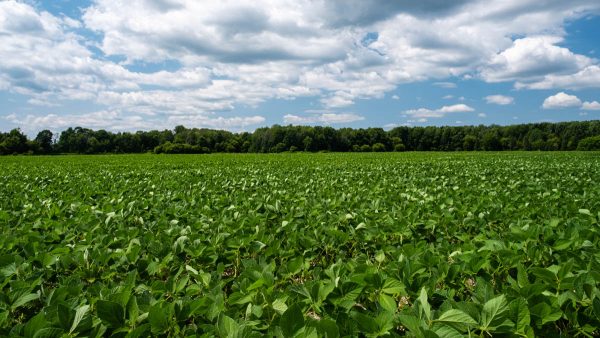
An Ontario soybean field. Soybean prices increased when the U.S. announced more biofuel will be required in fuels.
Price Bump
U.S. mandated higher biodiesel volumes in fuel and handed Ontario farmers a price gift
Friday the 13th was a good day. On June 13, 2025 the United States Environmental Protection Agency released its long-awaited Renewable Fuel Standard for the next two years, and the targets they have established are welcome news for an oilseeds market which has been struggling for a reason to be optimistic.
 In the hours following the release of the new Renewable Fuel Standards, soybean futures rallied 2 %, soybean oil prices rose by more than 6 %, and canola seed futures prices rose by 10 %, all in response to raised targets for biodiesel inclusion levels.
Most importantly, these new biodiesel inclusion rate targets are in place until the end of 2027, so this is not a “flash in the pan” but rather a policy statement which will be in place for the next 29 months.
A person practically needs a post-graduate degree in acronyms to understand the documents pertaining to American biofuels, but here’s the basics of how the policy framework is structured.



The EPA, (Environmental Protection Agency), establishes targets for biofuel usage called RVO’s (Renewable Volume Obligations), which refiners, distributors, and retailers of liquid fuels in the United States are expected to achieve. In the policy documents, the RVO’s are measured in RIN’s (Renewable Identification Numbers), which are a specific 38-digit alpha-numeric code assigned to each gallon of biofuel covered under the American RFS (Renewable Fuel Standard).
RIN’s are essentially a tradable currency of tax credits, but since in fuel volumes, each RIN equals a gallon of fuel, for the purposes of understanding the EPA’s policy announcement on the commodities market, simply focusing on gallons of demand is the clearest way to view the announcement.
For the oilseed markets, the RVO’s (the volume obligations) established for bio-mass based diesel fuel are good news. For 2026, the RVO for biodiesel is 5.61-billion gallons for 2026, and 5.86-billion gallons in 2027. Those volume obligations represent a massive increase over the 3.35-billion gallon biodiesel RVO in place for 2025. These volume obligations also exceeded the market’s expectation of an biodiesel RVO in the range of 4.60-billion gallons.
One of the key reasons why there were concerns about the 2026 and 2027 renewable fuel RVO’s was that Lee Zeldin, the EPA Secretary nominated by President Trump, was an enthusiastic legislative opponent of the Renewable Fuel Standards when he served in the U.S. House of Representatives.
The previous set of renewable fuel RVO’s were released in June of 2023, and were due to expire at the end of this year. Considering how much political and ideological change there has been in the United States since 2023, there was a healthy degree of anxiety over what the new RVO’s might mean to grains and oilseeds producers. Although the new Renewable Fuel Standards do not establish very much growth for ethanol RVO’s, it is clear that the EPA has taken into account the uncertainty in U.S. oilseed demand and taken some steps to reassure the market.
Soybean oil is not the only feedstock that can be used to make biodiesel, but this substantial increase in the mandated requirements for biodiesel is the first good news that the soybean market has seen in a long time. With two consecutive years of good growing conditions and big soybean crops in South America, and the obvious trade tension and uncertainty between the U,S. and the world’s biggest soybean market, China, there has been a shortage of confidence in the demand for American soybeans. That has played out in softer prices in the Chicago soybean futures markets which has a direct impact on the prices received by Ontario farmers for their soybeans.
Another significant development in the new Renewable Fuel Standard (RFS) guidelines are limitations on using imported feedstocks for biofuels sold in the United States. The devil is always in the details on regulations, but in principle the new regulations make biofuels, made from imported feedstocks, such as used cooking oil from China, or sugar cane ethanol from Brazil, ineligible for receiving a RIN, and therefore will not be counted as part of the Renewable Volume Obligation. This change falls neatly in line with the America-first policy, and will ensure that more oilseeds grown in the U.S. will be processed and consumed in the US.
A substantial increase in American biodiesel usage will not fix all of the problems with soybean prices. (those are primarily the result of a South American supply glut), but it will certainly help.
In the commodity markets, many of our price rallies are short-term reactions to undeveloped problems. We see this with things like weather rallies, where prices rise for a few days, and then it rains and values fall back. These increased RVO’s (Renewable Volume Obligations) will require an increase in the production of U.S. biodiesel, and these volume obligations are in place right through to the end of 2027. So, they will impact the demand, not just the crop that is growing in the field this summer, but for next year’s crop as well.
Finally, some good news for the oilseeds market.
Steve Kell is a Simcoe County crop farmer and handles grain merchandizing for Kell Grain, with elevators in Belleville and Gilford.