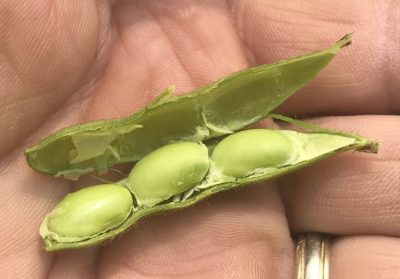
Soybeans NOT ready for spraying
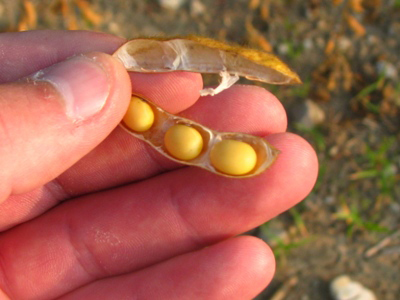
Soybeans ready for spraying
Soybeans: pre-harvest weed control
OMAFRA’s latest crop report stressed pre-harvest weed control.
 A pre-harvest herbicide treatment can make harvest more efficient when there are an unacceptable number of weeds in a soybean crop. Drier plant matter will pass more easily through the combine, lowering seed losses and reducing seed staining.
Pre-harvest herbicides do not speed up how fast soybeans mature, nor make soybean seed dry down faster. But they will speed up harvest timing by 1-3 days because remaining leaves will drop more quickly, and green material will dry up. Green tissue on soybeans such as leaves, stems or pods, will be killed, but green seed does not dry down more quickly. Crop quality often increases because the harvest timing after the field has been sprayed is more predictable, and therefore harvest schedules can be better managed.
Most importantly a pre-harvest burndown will dry down weeds, making combining easier and will clean up the field for winter wheat planting.





If perennial weeds are the target, glyphosate is the preferred product because the shorter days and cooler temperatures that occur in the fall act as a trigger for perennial weeds to reallocate sugars to their roots for over-winter storage.
Application timing is critical. Do not spray too early. If application occurs too early, yield losses can occur, and chemical residues will be taken into the seed. Herbicide residues in the harvested seed will result in marketing problems. If large patches of soybeans in the field remain green, it will be necessary to wait for those areas to mature before spraying. It is safe to spray when seed fill is complete. This can be determined by a colour change of the seed from green to yellow. A change in colour of the pods is an excellent indicator that the seed has also changed colour.
Another way to assess if the field is ready is to determine if the seed has separated from the pod. Once the seeds turn yellow, the next visual change is that the seeds start to shrink inside the pod and separate from the white membrane inside the pod. This test is most accurately done by collecting random pods from the top one-third of the plant. If all the seed has separated from the pod, then the crop can be sprayed.