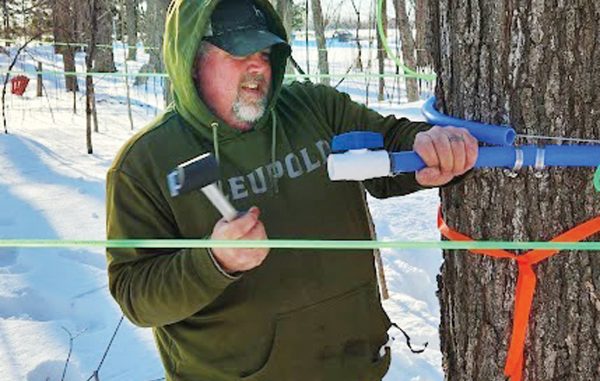
Mark Clifford, of Valley Maple Worx, installs and maintains maple systems across Eastern Ontario.
With maple syrup you make your money in the woods
And the money is there, producers say
Charles Summers
Special to Farmers Forum
“You make your money in the woods,” is the saying that you hear over and over again in the maple industry, and it’s a fact. You can have the comfiest sugar house with the shiniest stainless in it, but if you don’t have much sap, you can’t make much syrup.
High vacuum, solid tubing installations, good forest management, a watchful eye and busy feet are how you get the most sap possible, but that can be very difficult to achieve when you’re busy concentrating, boiling and filtering during the peak of the season. But what if there was a way a producer could focus entirely on their bush?
Over the past few decades, maple production has gone from a cottage industry to a competitive, high tech commodity trade. In places like Vermont – where the business has quadrupled in 20 years – you’re witnessing a trend that you see throughout agriculture: specialization. The emergence of “sap only” producers has taken off, where woodlot owners (and renters) capitalize on forest resources by selling only sap, avoiding the tremendously expensive investment in the buildings and equipment required to produce economically viable volumes of finished syrup.




The arrangement works a bit differently in every situation, but it more or less works as such: the sap collector and the boiler come to an agreement on shares, the collector receiving anywhere from 50 % to 65 % of the finished product of the sap they bring in. The sap is measured for sugar content and with some simple math it is determined how much syrup it will yield. They’re paid either in the finished product directly (which they can market as they choose) or paid in cash based on bulk prices given the grade of the finished product.
Ian Roth makes syrup from 17,000 taps in Waterloo County. Down in farm country, he collects from multiple woodlots and is no stranger to hauling sap — “we get excited to find a bush more than twenty acres.” Being an electrician by trade, he runs a state-of-the-art operation with capacity for more production. “I would buy sap all day, because when you buy sap, you’re buying labour and you’re buying land” — which is notoriously expensive in his neighbourhood. For better or worse, he hasn’t found any to purchase — boiling syrup is still seen as part and parcel of the maple business in his parts.
John Tomory and his brothers run multiple sites near and far from their home in Durham County, managing over 40,000 taps. “We’ve oversized everything for growth. We could take on another 20,000 taps worth of sap — we want it — but it’s a trick getting people on board with something that we don’t see being done much here.”
John is a bit of a wunderkind when it comes to maple, and derives a lot of his inspiration from the industry’s trajectory in Vermont. “I think that sap-only production in Ontario could be huge: we have the forest resource, first of all, but it’s also a great business in terms of lifestyle for the producer. Absolutely, you have a demanding couple of months where you babysit a vacuum pump and walk the woods everyday, but you also have another ten months of the year to augment what could be a really good income.”
Sap only production is a great opportunity for both new entrants and existing woodlot owners to enter the maple industry with minimal investment. You don’t need any of the big ticket items normally associated with maple: an electrical hookup, a couple of sea cans, a collection system, and you’re off to the races. Depending on the arrangement, a sap producer may not even need reverse osmosis or transport (often provided by the syrup maker).
Unlike Ontario, Vermont pours public resources into helping their maple industry, primarily in the form of research and extension services. What they’ve discovered is that sap only production is actually the most profitable avenue in the maple business.
Installing a collection system might run you $20 per tap. With good yields afforded by the sap producer’s undivided attention, gross receipts can range upwards of $10 per tap given current bulk prices. It doesn’t take long for it to pay for itself and become profitable. As with anything in farming, don’t count your labour!
Mark Clifford operates Valley Maple Worx: installing and maintaining maple systems across Eastern Ontario. Mark has developed a relationship that points a way forward for new entrants and existing producers. Golden Moments Maple, in Plum Hollow, have forged a working arrangement with Mark whereby he takes shares on their existing (and constantly improving) sap collection which he maintains and develops, while John and Norma Bamford take care of the boiling and marketing. The older generation maintains their investment in the stainless side of the business, while the next generation can pour their energy into the woods: where the money is really made.
Mark thinks there is tremendous opportunity to take advantage of sap only production in Ontario for both land owners and renters, with two caveats: move into it in stages, and scale it. Don’t try to tap the entire bush at once. Bite off a few thousand taps at a time. Do it well. Funnel the profits into the next stage. It all comes down to getting a lot of sap. Within a few years you might have upwards of ten thousand taps: at which point you have a serious small business.
This is where Garth Hume is at. Three years ago, he bought his dream maple property after two decades of searching: 153 acres of bush in Woodford, Ontario. He started with 3,000 taps, and as of last year was up to 7,000. He’s been concentrating his sap to 20 Brix and hauling it a daunting two hours away, where he’s paid upfront for the thick product. This work and investment have paid well enough that he is parlaying it into an opportunity to buy his own evaporator. Garth can attest to the viability of sap production, but wants to turn his 10,000-tap potential into a full-time livelihood, in which case he wants to extract every dollar from his bush by turning it into syrup and more.
Every bush is different and so are the circumstances of every potential collector and boiler. Farming leans on mother nature and technology, but at the end of the day it all comes down to manpower and working relationships. Ontario has more potential taps than any region in all the world of maple: the main thing we lack is the people to put in the work and the connections to build this industry to its full potential. If you own trees, have a sugarhouse, or want to work the woods, it’s time we start talking, investing, establishing alliances, and thinking about how we can turn these trees into a long term, economically viable source of rural income.