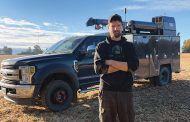
When the province banned wild boar, Hans Lindenmann didn’t fold up his tent and quit. He invested in Red Wattle pigs. (Lindenmann photo)
Wild boar producers shift gears as ban bites
Nelson Zandbergen
Farmers Forum
VANKLEEK HILL — Two of Ontario’s better known wild boar producers have switched to other heritage breeds as the provincial ban on Eurasian Wild Boar took effect at the end of 2023. Existing breeders had until Dec. 31 to be rid of the species — the granddaddy of all domestic pigs — though they can continue selling any leftover meat.
The Lindenmann family of Prescott County and the de Martines family of Perth County both say they’ve found a replacement for wild boar. Hans and Marianne Lindenmann are raising Red Wattle pigs, while Fred and Ingred de Martines have added the Mangalitsa breed to their operation.
They were among a group of only five or six Ontario farms stocking wild boar when the province announced the impending ban in November 2021. Officials feared that the animals posed too much of an environmental problem and a disease risk to mainstream pork producers if they escaped.
The Lindenmanns and the de Martineses both turned down a $200 per head offer from the province to hurry up and kill off their herds almost immediately. Instead, they gradually slaughtered and sold off their wild boar pork in the months leading up to the final deadline. Both farms sent their last few wild boar to slaughter in December.

It’s really only now that these producers are abruptly losing their wild boar revenue stream. 2023 was an otherwise banner year for wild boar pork sales, they both say.
“As of right now, we haven’t felt any loss. It’s going to be in the coming season to see if our clients will keep supporting us,” Marianne Lindenmann said in mid-January
She and her husband gave out samples of Red Wattle pork to some of their wild boar meat customers to build interest in the new product and response has been good. The couple sells from their farm gate and at farmers markets in Ottawa (Sundays at Lansdowne Park) and Vankleek Hill (Saturdays)
“We’re just moving on, there’s nothing we can do about it, but of course, we’re bitter,” Lindenmann said. “Because from one day to another, they can just take your business away that you’ve been working at for 20 years. We had our best sales ever in 2023. So our business is at its peak, and we have to switch.”
They were sold out of regular wild boar cuts but still had a couple of months’ worth of trimmings to make their popular sausages that are mixed 50 % with venison from their 200-head domestic deer herd. Red Wattle pork will eventually substitute into the sausage recipe. Their Red Wattle herd stood at 40 by the turn of the New Year — built up from just a handful of animals purchased in 2022. That’s about half as many as their prior herd of wild boar.
The switch has cost several thousand dollars, Hans Lindenmann estimated, because the Red Wattles — unlike wild boar — require some protection from the weather when raised outdoors on pasture. He’s had to invest in calf hutches and other shelter structures, and he’s had to change his company logo and website.
When the province announced the ban, “I could have loaded all the deer and all the boars in a trailer (for slaughter), and that’s it, I would have quit,” he recalled unhappily. But logistically, that would have yielded too much meat to handle, and he would have needed to rent additional freezers or sell at a discount.
The Red Wattle pig offers a lighter, more marbled pork compared to its wild boar ancestor, Lindenmann said, “so it’s more juicy” and “a little more forgiving on the barbecue.”
Fred de Martines was similarly enthusiastic about a growing herd of Hungarian Mangalitsas and crossbreds at his hog farm, which was already diversified with regular commodity pigs and Tamworth and Berkshire heritage breeds before the province outlawed wild boar.
The flavour of the new pork “is unheard of,” said de Martines. “Once you’ve had it, you’re lost because you’ll never go back to anything else.”
Wild boar were most valuable for their marketing cachet, he explained. “It was so much easier to get people’s attention … You tell them you’ve got wild boar, then all of a sudden they perk up. You get their attention right away, and they listen to you, and then they’re more into what else you’ve got. We’re hoping the purebred Mangalitsa does the same thing.”
He pointed to the irony of the province banning wild boar while pigs of any other breed are still permitted to be raised outdoors on pasture. “It’s such a dumb thing they did (banning wild boar),” he observed
No wild boar ever escaped from their farm, according to de Martines, adding the province’s wild boar tracking website shows no reports within a 100 km radius of the operation. He suggested the province would have been better served focusing its efforts on wild boar populations that make their way into Ontario from Manitoba.
Hans Lindenmann also reported no escapes from his farm.
Ontario could have laid out specific regulations for fencing pigs outdoors and left the wild boar industry in place, as Saskatchewan and Manitoba did, he said.
Even now, Ontario has no swine-related fence regulations after slapping down North America’s first wild boar ban, according to Lindenmann. And yet, feral pigs — not Eurasian Wild Boar — are the majority of wild pigs on the loose in the U.S., he said.
He also took exception to the widely reported stat that a wild female can produce up to 100 piglets in a year. That may be the case down south but not in Canada because of our long winters, he said. And if the species’ reputed fertility were true, “then everybody would have farmed wild boar because it would have been that easy to raise them.”