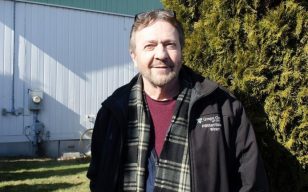
Nick Thurler’s farm has GET’s first digester, which is just about ready to start sending methane to market.
There’s money in manure
Winchester-area dairy farm with methane digester set to send each $10,000 truckload to the U.S.
Nelson Zandbergen
Farmers Forum
ST. ISIDORE — The USA will get the renewable natural gas that’s set to be produced by the first four centralized biogas digester hubs processing Ontario dairy farm manure and other on-farm waste into saleable energy. The sophisticated multi-million-dollar biodigesters — each designed to handle the manure of about 10 farms — are planned by GET Corp, a company spearheaded by Brinston-area dairy farmer Nick Thurler in partnership with the Danish-based manufacturer, Green Island.
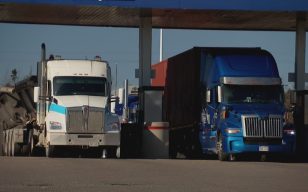
Each digester is designed to produce about 60,000 litres daily of renewable natural gas (RNG) — or methane — which will be trucked away and injected into the natural gas grid. For the methane yielded by GET’s ‘pilot’ group of manure digesters — one in Eastern Ontario and three in Southwestern Ontario — the final destination will be the American gas grid “because the monetization is just so much better,” company CEO Shikha Jain told farmers gathered at the annual Dairy Day conference in St. Isidore.
Meanwhile, “Canada is still working on a lot of its protocols, which have just been released this month,” Jain said.




Eastern Ontario dairy farmer Nick Thurler partnered with a Danish company to build a digester and move methane.
Sending the gas stateside is “not a long-term solution,” she added, although the available carbon credit scheme south of the border is currently more profitable for GET.
Carbon credits account for more than 50 % of the $10,000 per truckload sale value of RNG, Thurler and Jain told the group. Expenses, such as trucking manure to and from the participating farms, come out of that gross figure.
While the election of Donald Trump as president has created uncertainty in the carbon credit market, Jain said it wasn’t a “show stopper” and that GET had other options. “Just yesterday I had a meeting about a potential export opportunity,” she said.
Thurler said the initiative was premised on a 10-year return on investment period, under the previous carbon-market conditions. “Now it might be 12 (years),” he suggested.
Building a standard GET Corp. manure digester, using Green Island’s design and sand-removal technology, costs about $14 million, he estimated, given the drop in the Canadian dollar. With partnering farmers, the company hopes to erect 40 of them after the initial pilot group and ultimately more than 300 such digesters across Canada. The enterprise touts itself as helping to meet the Dairy Farmers of Canada’s 2050 net zero goals, now recognized as an almost impossible task unless the government plans to decrease agriculture production. Yet, even with the political uncertainty of a coming federal election, Jain predicted that net zero isn’t going away.
“Some of these goals may see some shifts but we don’t believe that it’s going to disappear all together,” she said.
Farmers have three ways of participating in the initiative:
• If within 25 km of a GET communal digester, they can sell their manure to the company for $4 per tonne and receive back the digestate, which is supposed to be 35 % more nutritious to crops than raw manure. They also collect a share of RNG revenues.
According to Thurler, the extra money in the farmer’s pocket is equivalent to a $2 per hectolitre rise in their milk cheque.
• They can lease their land to GET for $5,000 a month and host a digester, also selling their manure into the system as a regular participant.
• They can host and own a digester on their farm, with 30 % down required toward the $14 million cost.
Revenues and expenses will be shared equally across GET’s operations as a way of “de-risking” the business for the participants. No individual group of farmers will lose revenue if the digester in their neighbourhood temporarily goes down. This collectivist approach is borrowed directly from supply management.
Thurler said they also intend to collect other forms of farm waste, including used bedding pack material, baled corn stover and manure from hog and chicken farms. They’re not permitted to use saleable crops for methane generation as happens in Germany, according to Thurler. He reported that corn silage crops account for 80 % of the material consumed in Germany’s farm-based digesters.
Thurler’s own farm has GET’s first digester, which is just about ready to start sending RNG to market after a year-long delay involving Ontario’s Technical Standards and Safety Authority. “They wish they were involved earlier,” he said of the TSSA, “so we had to make a few changes.”
However, the unit was running for a period of time and, in a positive sign, produced more methane than Thurler’s Danish partners projected. “I always told them the Canadians’ s— was better than the Danish,” he quipped.
He noted that it would take about 1,000 to 1,200 cattle and their young stock to produce enough methane to fill one truckload.