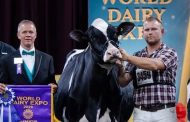
Stormont County dairy farmer Howard Quail
Nelson Zandbergen
Farmers Forum
MONKLAND — A painful allergy prevents Stormont County dairy farmer Howard Quail from eating beef, pork and cheese, but that may not be the worst of it. He can’t even milk his own cows anymore. If he gets too close to the them his eyes and face puff up.
Quail, 58, has Alpha-Gal Syndrome (AGS), a very rare condition in Canada. Quail is the first reported AGS case in Ontario. There are only two publicly-reported cases in Canada. The second case is of a Nova Scotia woman.
The allergy has been traced back to a lone star tick bite while out in the field in the summer of 2023. The diagnosis was confirmed later that year after a positive blood test performed by the provincially approved Dynacare lab in Winchester.
AGS has made recent headlines across North America because of the bizarre red meat and dairy allergy that comes with it. More specifically, sufferers become allergic to the alpha-gal sugar molecule found exclusively in mammal meat and blood. The lone star tick exclusively transmits the condition.




“I really miss what I used to eat,” Quail, a self-described “steak and potatoes guy,” told Farmers Forum at the farm south of Monkland. Gone are his days eating pizza and his great love for cheese.
Chicken and fish are the only remaining dietary sources of animal protein for the fifth-generation dairy farmer and father of 8. “I sometimes put a little milk in my coffee, but not a lot. And if I do, my eyes kind of start to swell up.”
His face and eyes also swell if he tries to work with his 45-head production herd, leaving him unable to help with milking chores or assist with birthing calves, as fluids and afterbirth trigger flare-ups.
But that’s the milder version of what he endured for months before he was diagnosed. The ordeal began in June 2023. Quail felt a sting between his shoulder blades while out bush-hogging. He believes that was the moment an infected tick bit him, though he never saw the pest. Within days, his entire body erupted in severe swelling and a painful, peeling, seeping rash, especially his legs. The skin cracked painfully in places, making it difficult for him to move.
“He looked like a burn victim, almost, with the skin shedding,” his wife, Connie, recalled. He lost his energy and spent a lot of time on the couch.
They believe his body was reacting to his regular diet. At one point, they went out for a breakfast date where he enjoyed a sandwich with bacon. It caused his legs to flare up. “My elbow just blew up,” Quail said.
Despite visits to regional emergency rooms and a dermatologist, local doctors were initially baffled by his condition.
The turning point came when a Brockville-based nurse practitioner ordered an Alpha-Gal test through a Winchester lab. The test came back positive. Additional blood work sent earlier to a lab in Germany revealed that Quail had also contracted Babesiosis, a nerve-attacking infection caused by the Babesia parasite also known to be carried by ticks in Ontario. Health authorities acknowledge that Babesiosis exists in Canada, counting 10 cases nationally in 2024. Quail believes this is causing joint pain in his feet.
As it stands, no government in Canada tracks Alpha-Gal Syndrome numbers. The lone star tick is native to southern U.S. states and is gradually moving north. Researchers say the ticks hitch rides north on birds and travellers each season. The etick.ca self-reporting website recorded 80 photographs of the tick collected by Ontario residents as of the end of July this year. The lone star tick was first detected in Ontario in 2019.
For Quail, the diagnosis forced drastic life changes. In addition to dietary changes, the family also had to cut household items for hidden mammal products, swapping out soaps, toothpaste, and shampoos. His symptoms were so bad at first, he worried about the future of the farm that had been in his family for five generations.
“The doctors had recommended to get away from the mammals like totally,” Connie explained.
Even airborne exposure or minor contact can set off a reaction. He was so sensitive that cooking red meat in the farmhouse or being near airborne barbecue smoke caused Quail’s face and eyes to swell.
Sizzling bacon in the kitchen one morning gave him such a reaction that he and his wife temporarily moved off the main farmstead to a second house on the property for eight months to isolate him from the allergens. During his eight-month absence from the barn, the couple’s children — ranging in age from 10 to 23 — stepped up to run the organic dairy operation.
“I’ve got a great family that, you know, picked it up and took care of everything and they matured a lot through this and kept everything going,” Quail said.
Quail now limits his in-barn activity to feeding the animals. His health is otherwise good now that he knows what he can’t eat. He’s not tempted to take another bite of steak because of the agony it causes.
He hopes that sharing his story will help raise awareness with farmers about the risks posed by ticks.
“It can happen to you,” he warned, adding, “I never thought it would happen to me.” He advises farmers to take precautions and seek blood testing immediately if strange symptoms follow a tick bite.