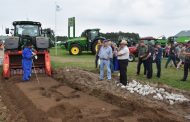
Protesters express their outrage at the Alto bullet train project on Parliament Hill, earlier this year. Farmers Forum photo
Nelson Zandbergen
Farmers Forum
EASTERN ONTARIO — In a striking twist that underlines just how toxic the federal government’s proposed Alto high-speed rail project has become across rural Eastern Ontario, many in the region found themselves quietly cheering as Quebec voters last month elected a separatist government that opposes the project.
The Parti Québécois (PQ) victory breathed new life into the grassroots struggle among rural Ontario property owners determined to stop the bullet train from cutting a disruptive swath through their communities. PQ leader Paul St-Pierre Plamondon promised to block the project if elected.
The PQ won 59 of 127 seats, only good enough for a minority government. But Quebec voters also rewarded another anti-Alto party, the Conservatives, who picked up 19 seats after an 80-year absence from the legislature.
The controversial megaproject that’s supposed to connect Quebec City to Toronto by the early 2040s has an outrageous cost, recently estimated by the Parliamentary Budget Officer at $113 billion. At the same time, Alto has grossly overinflated the estimated users of the system, revealing that the high-speed train would become an endless financial liability and never earn a profit, according to Dr. Ian Lee, an associate professor at Carleton University’s Sprott School of Business.








St. Isidore elevator operator and crop farmer Karine Bercier was optimistic about the impact of the newly elected PQ government. “We’re hoping that they’re going to stand their ground and that they will walk their talk,” said Bercier, who couldn’t have imagined herself hoping for a PQ win before Alto. “I think all of us were rooting for them, to be honest.”
St-Eugene dairy farmer Jeff Leroy said that “a lot of my friends on the Quebec side never voted PQ before, but this time they did.”
Leroy, who helped organize a major Sept. 19 anti-Alto rally in Rigaud, Quebec, said that the Quebec provincial government “will have some power against the (federal) Liberals.”
“I think it (the PQ win) gave people some hope,” said ‘ALTNO’ co-founder and Prescott County resident Kristin Muller. “(Ottawa) obviously can’t run the project without Quebec support.”
Navan farmer Wyatt McWilliams echoed that sense of conflicted relief. “I know some people were cheering for the PQ to win,” McWilliams admitted. “It’s a sad way to have to look at it, for sure.”
Prominent anti-Alto legal strategist and lawyer Erin Durant noted by email that, in the wake of the PQ win, the project “might die or transform, we will see.”
Durant added, “There is a cooperation agreement signed by Quebec that they can back out of which makes the project much harder to push through against the will of citizens and communities … My bet is (the PQ will) cancel the cooperation agreement.”
MP Scott Reid (CON – Lanark-Frontenac) has previously pointed out that Quebec could theoretically deny electricity to the electric bullet train, stopping the project dead in its tracks.
Despite the political earthquake in Quebec, the Carney cabinet put on a brave face the day after the provincial election. Transport Minister Steven MacKinnon asserted that Alto would move forward, calling it a “transformational project for the entire country and for Quebec.”
But earlier in the summer, MacKinnon conceded to The Toronto Star that there was “no Alto project without Quebec.”
The PQ win comes less than three months after the Ontario government seemingly turned hostile to Alto in a tit-for-tat over Toronto’s Billy Bishop Airport. Premier Doug Ford was angered when Ottawa turned down a planned expansion at the airport. Soon after, unnamed sources said Ford was “rethinking” its support for Alto. Eleven Eastern Ontario Progressive Conservative MPPs suddenly felt free to issue a joint letter critical of the project. But that brief outburst of discontent faded with new American tariffs imposed in September. Ford re-focused on economic national unity and repeatedly voiced support for the Carney government on the trade file.
Kristin Muller expressed frustration with the political maneuvering. Ford has “definitely gone quiet again (on Alto),” she said.
Wyatt McWilliams voiced similar concern. “Our guy, Mr. Ford better stand up and wake up,” he asserted. While reporting that his local Progressive Conservative MPP recently reassured him that the project “won’t happen,” McWilliams said he won’t be convinced — and won’t sleep well at night — until Ford and Carney also say it’s over.