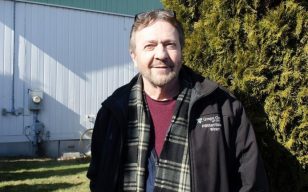
Canadian Federation of Agriculture president Keith Currie speaks at the annual general meeting in Ottawa on March 6.
Ottawa backs off on fertilizer restrictions, CFA president says
Farmers Forum staff
OTTAWA — While many Ontario farmers fear that government regulations will come down hard on fertilizer use, the Canadian Federation of Agriculture president Keith Currie says that Ottawa has backed off and credits push back from farmers.
“When this all came out two years ago, the initial words coming out of Agriculture and Agri-Food Canada was that they wanted to reduce fertilizer use by 30 per cent and we all gasped,” said Currie, a Collingwood-area hay and sweet corn farmer. “In doing some media interviews, we said that if they want to reduce fertilizer by 30 per cent that’s going to drastically reduce food production and there might be food shortages. Some of the mainstream big publications ran with that and it was to our benefit because all of a sudden the government started backtracking, saying, ‘No, it’s not fertilizer reduction, it’s nitrous oxide reduction.’”
Currie added that he was skeptical in the beginning but says the federal government has since been steadfast that nitrous oxide emissions reduction is a goal, not an obligation.
“They have really softened and the prime minister confirmed it at the (Canadian federation’s annual) meeting,” Currie said (see page B9). “He made it very clear. This is a goal, it’s a target. It’s not a must-have-to-do. So, that was good news.”
He said that the federal government has set a “loose goal of 2030” to reach its emissions reduction target.



Currie suggested emission reductions can be best achieved through various technologies in equipment, seed genetics and fertilizer enhancement and will require government infrastructure spending, including ensuring better broadband connectivity in the rural areas.
“I know that farmers are skeptical and they are afraid of regulatory reform,” Currie told Farmers Forum, adding that people will have their say at the ballot box if the government over reaches. “All you have to do is look to Holland and what happened in their elections. That didn’t go so well for the sitting government. People will have their say if the government goes too far.”
When pressed on the Dutch emission reductions that began as voluntary, he remained optimistic.
“We always have to be cautious with any government,” he said. “If farmers dig in their heels and say, no, then that tends to lead governments to say, ‘Okay, we are going to make you.’ We have to do our due diligence. We can’t lose the economic piece to this. We can only afford to do what we can afford to do. We’re willing to do our part but we can’t go bankrupt doing it. So, that’s why the carrot, rather than the stick is always the preferred way to go. And farmers have shown forever and a day that they will do whatever needs to be done as long as it is not completely on their financial backs to do it. The environmental farm plan is a prime example. It’s not mandatory but in Ontario, over 90 per cent of farmers have done an environmental farm plan.”