What is the best invention for the farm?
Thirty years ago I quizzed 50 farmers and asked them what they thought was the best invention that made life easier and better for farmers.
 There wasn’t one particular thing that stuck out as being the best. There were many. The round baler, tractor, combine, milking machine and hydro were mentioned the most.
It was in the late 1990s when making hay could be a one-man job with a round baler. Farmers liked their round baler. They were not dependent on hiring help anymore.
If I were to do that survey again, say next year, with younger farmers, the round baler and milking machines would probably not be mentioned.
The answers would follow the more modern things like autonomous tractors and harvesters, robot milkers, drones, GPS, smart phones, and all that technology on farms today.
If I were asked what I thought was the best invention that made farm life easier I would say the tractor and front-end loader. I love my loader tractors. Why? Because they pick things off the ground. You plow a field and a few big stones come up. You go over with your tractor loader bucket and dig the rock up with the loader and dump it somewhere.



I use a front-end loader when I’m splitting firewood blocks. I scoop the blocks up from my concrete yard and bring the blocks up to the splitter that sits on the 3-pt hitch of another tractor at a height for easy working. I’m not bending down and lifting blocks. Just sliding the blocks over to the splitter.
I’d say that the tractor and the hydraulics have changed life on the farm more than anything else in the last 100 years
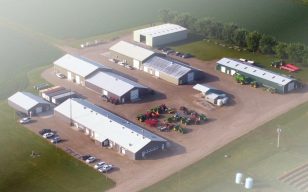
I often chuckle when non-farmers come to my farm for the first time. I have a storage business storing boats, RVs, vehicles and campers. It’s where I also keep my four tractors.
Someone made the comment the other day “Oh, you store tractors too!” And so many times I’ve had people say, “How many tractors do you have and how many do you need?”
They must think that one tractor is all a farmer needs. Tractors keep their value if you look after them. I tell them if I farmed with horses like in the old days I’d need at least eight horses and I’d have to grow fields of oats and hay just to keep them. Tractors are a real bargain. They don’t need to be fed and they only consume fuel when the key turns it on.
I have always had four tractors. Three of my four tractors have a front-end loader. I also have a large backhoe loader and an excavator. They all make life easier and I’m never picking heavy things off the ground.
Recently, I read an interesting article on how much feed it took to feed work horses and mules before tractors came on the scene. It took six acres of land per animal per year to harvest enough feed to sustain the animal. In the 1920s, Americans owned more than 25-million horses and mules, most of which were used as work animals on farms. By 1945, tractor power had exceeded animal power and the number of mules and horses shrunk to roughly 2.5 million animals.
My tractors are all in good repair and well looked after. When they’re not being used they’re inside a shed. They are never out in the rain or sitting outside in the snow.
I grew up with tractors from a very young age when we were doing loose hay in the 1950s. I drove the little grey Ford tractor pulling a wagon and the steel-wheeled hay loader while father forked the hay. When the load was full it would go to the end of the barn and a big steel hay fork was pushed into the load. I would drive ahead pulling a cable and the hay fork with a jag of hay would go up the side of the barn. It would connect to a rail up outside the barn and father would yell for me to stop. The hay fork with the hay would ride the track at the top of the barn where someone would pull a rope that was attached to the hay fork and the hay would let go off the fork.
How I liked when we got our first baler: A John Deere 24T. No more handling loose hay!
Maynard van der Galien is a Renfrew-area farmer and a long-time columnist with Farmers Forum.