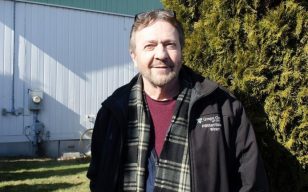
New BFO president Jason Leblond.
Farmers Forum staff
TORONTO – The Beef Farmers of Ontario passed 17 resolutions at their annual meeting and voted in a new president.
Former BFO vice-president Jason Leblond, from Northern Ontario, was elected president at the organization’s 64th annual general meeting held in Toronto Feb. 18.
“I love this industry, it’s fantastic,” Leblond told delegates after being elected. “We’re super lucky (with this board.) My ambition is to do what the industry and producers are telling us to do. It’s that simple.”
Leblond is a Powassan-area producer and a certified engineering technologist who operates a 35-head grass-fed cow-calf operation.
The 17 resolutions, which will be presented to the BFO executive for approval, are outlined below.
• Lobby to make permanent the minimum interest free portion of Advance Payment Program of $350,000


• Prioritize agriculture and food literacy as part of its provincial government advocacy and lobby priorities; and work in partnership with AgScape (agriculture in the classroom organization) to identify and advance specific advocacy objectives and talking points that will support consistent, meaningful agriculture and food literacy implementation when engaging with government and industry partners.
• Make a request to the Minister of Agriculture to implement a breeder finance program and a provincial loan guarantee and mirror the successful aspects of the Ontario Feeder Cattle Loan Guarantee Program.
• Lobby for more ways to control the coyote population and decrease the effect of the coyote issue on beef farmers. BFO notes that not all counties and districts have a bounty on coyotes and the compensation for loss of life due to predation does not always cover enough of the loss.
• Explore every possible avenue to ensure every county and district has 24-hour veterinary services for their cattle.
• Lobby the provincial and federal government to see if they can have banks move back to the way they did business before, or at least better than what we have today. Note that within the past two years banks have started putting up to seven-day holds on cheques and certified cheques, causing more bounced cheques in the agricultural industry.
• Work with CFIA to ensure proposed regulations do not drastically increase cost of production, bureaucracy, or administrative burden for cattle producers; and
support traceability systems that are practical, efficient, and producer-driven, and that do not impose undue financial or administrative impacts on the cattle industry.
• Work with OFA and the other livestock associations and continue to lobby to have separate legislation written for livestock. As the PAWS Act is written, it calls for livestock to be adopted out if the farmer is unable to meet the requirements of an inspector or if he or she cannot pay the fees for the cattle to be taken.
• Lobby to have RMP enrollment recognized to satisfy requirements that allow access to APP through ACC.
• Work with CCA and other provincial cattle associations ensuring the CFIA is held accountable for the rules that are developed and enforced. BFO notes that “the CFIA continues to develop regulations and enforcement and there is no one to oversee their work.”
• Lobby the government for some type of tax relief program for these abattoirs in order for them to remain open and provide local food within our province.
• Have RFID tags be read in only, noting that tags do not affect traceability effectiveness and “it can put the farmers’ and truckers’ and handlers’ lives in danger.”
• Lobby OMAFA to clarify in black and white the conditions for carcass condemnation that is based on scientific testing rather than interpretation of inspectors with varying degrees of experience. BFO notes “inconsistencies in inspections across plants and that inspectors are left to interpret their observations to central vets, influencing decisions on whether or not to condemn a carcass.
• Work with commodity groups to steer conservation authority back to their original mandate to control water flow and allow farmers to continue to implement best management practices to continue to produce food. BFO notes that farmers are burdened by conservation authority over regulation.
• Lobby with other provincial beef organizations and the CCA to encourage the Minister of Health to have our processing standards align with all of the countries that we import beef from. BFO notes that it has been more than eight years since Canada was granted “negligible risk” status and the Canadian Food Inspection Agency still requires processors to remove and pay to destroy the extra SRM material that is not required of beef imported from other countries.
• Continue to make access to Crown land for the production of beef in the province of Ontario a top priority among lobby efforts. BFO notes that access to Crown land is a limiting factor for producers.
• Voice objection to the $90 billion high-speed rail link between Toronto and Quebec City. The high-speed link would cut through Frontenac County and Eastern Ontario causing many farms to suffer expropriation and have lands divided by a fenced rail line. BFO delegates argued that “we see no social or financial benefit to the communities as there is no opportunity to utilize the service.” They also argue that “many local roads will be closed and wildlife movement disrupted.”