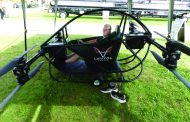
Dwayne Henderson’s new drone can carry a 150 kg tank. (Nelson Zandbergen photo)
Ag drones keep getting bigger
Nelson Zandbergen
Farmers Forum
WOODSTOCK — A new Canadian-made agricultural drone that flies with wings like an airplane — but also hovers like a chopper — wowed the crowds at Canada’s Outdoor Farm Show in Woodstock. With a wingspan of 33 feet and a 45-foot spray swath, the big drone proved to be the most physically imposing unmanned flying machine demonstrated yet at the annual Woodstock show.
Forward Robotics, of Cambridge, developed the so-called ‘U9HL’ model. The firm is affiliated with Great Lakes Helicopters, a traditional helicopter service company owned by Woodstock-area dairy and poultry farmer Chad McIntosh that has been spraying crops with regular choppers for decades.
Priced at $129,000, the U9HL also has four rotors for the full vertical and takeoff and landing (VTOL) capabilities of a typical drone, only the rotors aren’t fixed in an upward position. Once in the air, the rotors tilt forward to become more like propellers and the wings take over to create lift.





In addition to energy savings and greater range, the developers say the airflow over the wings produces a smoother, more uniform spray distribution pattern over the crop canopy, similar to a full-sized helicopter or airplane. Flaps located beneath the wings help control the spray swath to avoid the swirling rotor wash and vortices that can cause inconsistent coverage with a conventional drone, according to the developers.

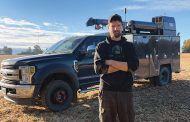
Dwayne Henderson, a Forward Robotics investor and traditional helicopter pilot, believes drones will replace helicopters for crop spraying. (Nelson Zandbergen photo)
“For me, it’s your spray pattern, your consistent swath that you’re getting with all the air over the wing,” Dwayne Henderson, a Forward Robotics investor and traditional helicopter pilot, told Farmers Forum. “At the end of the day, the farmer is paying all this money for his chemicals. He wants it to go where it’s supposed to go,” added Henderson, who previously owned Great Lakes Helicopters but remains involved with the drone endeavour.
University of Toronto engineers Meng Wei and Dr. Tamara Finlay established Forward Robotics in 2018. The duo developed and patented the technology allowing a drone to transition from vertical to horizontal, winged flight, according to Henderson.
Henderson believes “the writing is on the wall” for agricultural spraying by manned aircraft as drone technology improves. Demand for airborne spraying already exceeds the amount of helicopters available to provide this service, he added. “Southwestern Ontario will probably be nothing but drones in the near future instead of choppers,” he predicted, estimating helicopters have about four years left before drones completely take over the market in that region. Of course, the main hiccup is that while you can spray fertilizer by drone, the Ontario government is dragging its feet on approving drones for herbicide and pesticide spraying.
Also key to the U9’s appeal is an onboard AI (artificial intelligence) software allowing a single operator to fly up to four units simultaneously.
While the demonstrator in Woodstock included a 100 kg tank, it is capable of carrying 150 kg. The U9 can fly up to 97 km/h and cover 135 acres per hour, according to the developers, about 50 % more than the advertised maximum output of the biggest quadcopter drones. It can also travel two-thirds farther on a battery charge because of the inherent energy efficiency of the fixed wing, although battery swapping allows a regular drone to stay up in the air anyway.
Because the takeoff weight is more than 150 kg when fully loaded, operators require a Special Flight Operations Certificate (SFOC), a process the company helps manage for clients, according to Henderson. “I think what’s going to tick back drones a little bit is Transport Canada enforcement. Anything over that weight, you’re supposed to have a special flight operating certificate. Ninety per cent of the people that have bought drones do not have that,” he said, adding it takes 9 to 12 months to get a certificate. “We’re in front of all of that.”
A Transport Canada official was also at the show to raise awareness of that requirement for drones in the 150 kg category. When the drone’s own weight is added to that payload, it exceeds the exemption threshold and requires an SFOC, civil aviation safety inspector Richard Podolski told Farmers Forum.