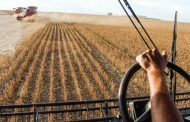
Yannick Burdan, has been growing black beans for six or seven years.
Nelson Zandbergen
Farmers Forum
OTTAWA — An expanding appetite for Mexican cuisine is rekindling interest in black bean production for Ontario farmers.
Among the edible dry beans grown in the province, black beans still trail white beans — aka navy beans, or brown beans when served up on a plate. But the black bean continues to take an increasing share of the 100,000-plus acres dedicated to Ontario’s entire edible bean crop niche, a class that also includes adzukis, cranberry beans and kidney beans. For comparison, Ontario farmers grew 2.9 million acres of soybeans last year.
Provincial planting numbers tell the story. According to Agricorp insured acreage data tracked by Hensall Co-op, Ontario grew 133,068 dry bean acres last year, including 21,428 acres of black beans and 64,463 acres of white beans. Twelve years earlier, in 2013, black bean production stood at just 5,415 acres to white beans’ 43,160 acres.
“I would also say that with the recent… popularity of Mexican food or Mexican-style food, the black beans have maybe increased in consumption,” said Wade Bickell, origination manager at the Hensall Co-op, the largest buyer of edible beans in Ontario. Bickell attributed much of this growth directly to popular restaurant chains like BarBurrito and Chipotle.





While market demand is driving interest, practical benefits in the field are keeping dedicated growers committed. For Yannick Burdan, who has been growing black beans for six or seven years near Goderich, the dark color of the seed coating provides a major management advantage over white beans, especially as an organic producer unable to spray the crop.
“They are not as susceptible to stain. I mean, they still need to be clean … but because the coating is black, you get away with a little more than with the white beans,” Burdan said.

Yannick Burdan created his own set up for harvesting black beans by mounting a 15-foot flex head, an air bar, and a Case feeder house onto an old Lilliston bean combine.
Harvesting remains one of the trickiest parts of raising the crop. Although black beans are easier to direct-harvest with a combine than older bush-style white beans, they are still more susceptible to mechanical damage than standard soybeans. Burdan initially lacked the equipment for direct harvest. He windrowed his black beans the old-fashioned way and then harvested with a pull-behind bean combine. He found the process frustrating in combination with the weeds in the windrow. So he fabbed up his own specialized and affordable combine that allows typical direct harvesting of the crop, but using a combine similarly pulled behind a tractor. He mounted a 15-foot flex head, an air bar, and a Case feeder house onto an old Lilliston bean combine. The setup cuts and threshes the standing beans cleanly, he said.
“The Lilliston bean combine is unbeatable when it comes to threshing quality and gentleness,” Burdan noted, adding that his harvested sample comes out looking “polished.” Even better, a Lilliston can be had for about $5,000, he said. And that makes black beans one of the best options for a crop farmer in his area to grow a premium-priced crop without an enormous capital equipment cost. “It’s a good area here to grow it too. Like, it works. They grow well.”
He’s also enthused about growing an edible crop. “My philosophy is, if I can grow food that humans can eat directly versus having to put it through an animal, then that’s kind of something to be proud of.”
But black bean growers must navigate marketing constraints and shifting pre-contract prices. Unlike commodity soybeans, edible beans must be pre-contracted through specialized dry-bean handlers like Hensall Co-op or Crooked Creek Acres.
Price fluctuations can also temper farmer enthusiasm for black beans in favour of some other edible bean. Andrew Frew, a crop grower near Port Perry, chose to walk away from black beans this season entirely due to a dip in the forward-contract market. Frew took his first stab at the crop last year, but it fizzled in the 2025 drought that slammed his region. But he would have tried again in 2026 if not for a drop in price.
“The market is not there for them this year,” Frew explained. “White beans are worth more than black beans, so there was more incentive to grow the white beans this season.”
Lambton County crop producer Brad Langstaff echoed that concern. While he doesn’t grow black beans himself, Langstaff asked a couple of relatives who do grow the crop if they planted any this year. “They said there was not enough premium,” he reported.
Despite market swings for conventional black bean growers, organic production offers a bit more stability, according to Yannick Berdan. He said that organic pricing has remained relatively steady at around $0.80 a pound in recent years. While commodity soybeans may be a safer fallback, he said a successful black bean crop delivers a higher payout.
Organic black beans “are typically bought on a full production contract,” Helena Friesen, general manager at Crooked Creek Acres in Strathroy, pointed out. “So anything that you grow organically we will take” at a guaranteed price, she said, adding that a different offer applies to conventional black beans produced above a certain yield. “It could be more, it could be less.”
Friesen noted that while Crooked Creek exports white beans to Japan, the black beans handled by the company are consumed domestically. The company contracts roughly 4,000 conventional acres and 1,000 organic acres of black beans per year.
“I think black beans are a lot easier to grow than a white bean,” Friesen also observed, echoing Berdan.
Part of the crop’s long-term expansion is thanks to localized plant breeding. Varieties developed specifically at the University of Guelph for Ontario’s growing conditions have improved yields and made harvest far easier compared to older ground-hugging varieties, according to Hensall Co-op’s Wade Bickell. However, Bickell cautions that growers must still actively manage common fungal threats like white mould and anthracnose.
Careful management during harvest timing is equally critical. While some growers assume black beans can weather adverse conditions better than white beans, Bickell noted that harvesting them too early can turn the crop purple rather than black.
Both black and white beans average a yield of around 2,400 lb. (24 hundredweight bags) per acre in Ontario.