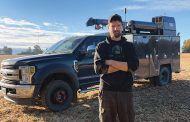
As a teenager Jeff DeJong wanted to get as far away as possible from farming. After a short stint as a plumber, he figured farming wasn’t so bad. (Charles Summers photo)

The DeJongs turned a 96-acre tie stall dairy operation into an 800-ewe sheep operation.
Handful of woollies and a future was born
Young couple worked for others, pinched pennies, rented, then bought, expanded family and herd and turned all that hard work into a growing business of their own
BAILIEBORO — One of the great paradoxes is that farming is considered an enterprise in which it is impossible to turn a profit, while at the same time regarded as too expensive for anyone to enter its ranks. There always seems to be too little or too much money in farming: anyone who would want to work for those wages is crazy, and it doesn’t matter anyway, because you could never afford to! A sort of self-defeating thought process that deters even people born and raised on farms from pursuing the profession.





 Jeff and Mandy DeJong throw all of that nonsense out the window. When you see their thriving, well established farm in Bailieboro — halfway between Port Hope and Peterborough — you might make the assumption you’re on a multi-generational undertaking. Despite their relatively young ages (37 and 38 — mere adolescents in FarmWorld) Jeff and Mandy are the first-generation owners of DeJong Family Farm, and the prosperous business they’ve built, they’ve built themselves.
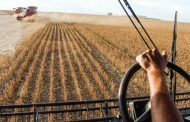
“When I was a teenager, I thought I wanted to be as far away from farming as possible,” Jeff chuckles at his recollection. A brief interlude into the plumbing trade reminded him that maybe farming wasn’t so bad. Growing up just outside of Port Hope, Jeff had been exposed to agriculture his whole life, but there was no easy pathway to his own operation. It was a season on the western harvest tour, at age 22, when Jeff pondered whether sheep might be the backdoor into a farming career of his own. “You have a lot of time to think when you’re combining 16 hours a day.”
At the time, Jeff didn’t have a crystal ball to tell him that lamb was going to become the hot commodity it’s become today (recent auction prices ahead of the Easter holiday were over $5 per pound on the hoof!). But it seemed like something accessible which you could take on with minimal infrastructure and investment. You can’t just walk into cash cropping or milking cows for a few thousand bucks, but you can buy a dozen woollies and take it from there. Jeff did just that; 16 ewes to be exact.

In 2017, Jeff and Mandy DeJong purchased a former dairy operation and converted it into a sheep farm. After years of hard work the operation is thriving. Their children Dawson, Grady and Charlotte help out with the chores.
With careful management, Jeff found he was able to turn a profit with lamb, even when buying feed and renting facilities. Before long, he paired up with a more established shepherd, Albert Botha, who took Jeff on as his hired man. Jeff and Mandy lived on farm learning the ins and outs of the business while building their own flock. The experience proved invaluable.
The DeJongs lived modestly as every year they grew their arsenal of equipment and developed their business. They eventually bought their own home, which proved instrumental for their next stage of growth. “The bank isn’t going to just get you off the street into a farm: you need to get into the market first,” Jeff explains their sober, step-by-step approach to the long road of farming.
So, in 2017, after much patience, the DeJongs had the good fortune to purchase a farm of their own, parlaying the equity they’d built into their house as the down payment for the property. They picked up a mothballed dairy operation. “It seemed like a fortune at the time.” Jeff grimaces in hindsight. The purchase price wouldn’t buy you a starter home in most Canadian cities today, and the property has easily more than doubled in value. What seemed incredibly risky at the moment has turned into a very affordable and wise investment.
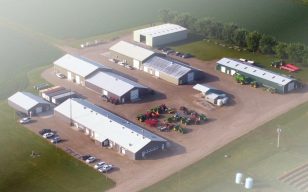
But it wasn’t a sheep farm! “I just love seeing things grow and come together,” Jeff grins with his infectious smile. It’s a good thing Jeff likes a challenge, because retrofitting a 96-acre tie stall dairy operation into an intensive 800-ewe sheep operation has taken incredible amounts of effort, ingenuity and expense, but what they’ve created is awfully slick!

In the toasty warm bottle lamb nursery.
Unlike cattle, which are easy to breed 12 months a year, sheep remain undomesticated enough that they naturally follow a seasonal breeding cycle. With some effort, you can trick them out of this habit, however, and the process is known as Accelerated Lambing. So, unlike a traditional sheep farm, where all of the lambing takes place in the spring, the DeJongs lamb year-round in groups about every second month, and they aim to get their ewes pregnant every eight months, working out to something like 2.8 lambs/ewe/year. This allows them to maintain a steady cashflow, shipping lambs every few weeks to local packers.
And so, while the popular imagination might envision the traditional shepherd dreamily strumming a lyre and gazing at the clouds, a modern Canadian sheep farmer has a demanding, management-heavy occupation, heavily invested in equipment and infrastructure. The DeJongs have quality, modern gear (because they need it to work), and rely on a handful of seasonal and part-time employees to help make their dynamic farm operate 365 days a year: even giving them a chance to take their three children skiing or to visit a waterpark for the weekend.
Little trips like that mean a lot to the DeJongs after years of driving clunkers and watching their grocery bills. All of the hard work and sacrifices are paying off. Creating life on a farm — from scratch — with the trimmings of a middle-class lifestyle is a huge victory for the DeJongs and goes to show that your dreams really are possible. But the DeJongs example shows that it is neither easy nor fast.
You can’t buy it, or just walk into such a position. It’s the cumulative result of tremendous dedication and risk, as well as a willingness to think outside the box. Turning an initially small investment into a going concern takes years and years of persistence. Perhaps Jeff’s greatest advantage is that he got started early and stuck with it. He didn’t spend his twenties partying or “finding himself.” He subjected himself to hard work for others, and turned those lessons into a well-ordered farm.
When you see the DeJong family all working together, in the bright natural light and airiness in the old hay mow of the former dairy barn they purchased (they turned the bank barn into a two-storey money-maker) you can see how sheep are one of a small handful of options that lend themselves to putting a family to work together on a farm. It’s oddly “kid friendly”: something you can’t say about most agricultural enterprises that rely more on heavy equipment than the human touch. Their young children are safe to work amongst the ewes and their newborn lambs. The best part is that they really are helpful.

The children are a big help on the farm. Mandy (left) supervises Charlotte, Grady and Dawson.

Even Grady, the youngest of the DeJong children, is safe to work with the ewes and lambs.
And the lessons they are learning: about life and work and business, might be the greatest gift they can pass on to their children (if you look beyond the family’s ever increasing net worth!). The kids understand that life is tricky, success requires tremendous sacrifice, and sometimes things just don’t work out how you’d like. The children see both the miracles of life and death at the same time.
The top three lessons I can take from the DeJongs are this:
1) Don’t be attached to “stuff.” If you’re a new entrant, owning a farm comes after developing an actual farm business. You can do that on other people’s property. And don’t think you have to do everything or have every tool. Jeff hired out a lot of field work before he could justify purchasing all of his own equipment. The sheep got fed and the lambs marketed regardless of who raked or baled the feed, and the cashflow just kept growing.
2) Invest in your farm. Living “low on the hog” means that you can put your precious dollars back into your operation, rather than your own status or amusement. The result is that over time you will have banked more than you can imagine, and the most important aspect is that you must invest in high quality things: Jeff bought a good farm on good land. His equipment is ready to work. He’s not shy to borrow on things he knows will pay out.
3) What I see that’s so special on the DeJong’s farm is something actually emotional, and perhaps even spiritual: unlimited positivity. Every challenge is an opportunity, every success is a gift, every failure is a lesson, and absolute confidence that if they just keep showing up and trying their best, things will just get better and better.
Jeff DeJong has gone from “I think I want to farm,” to beating the odds and making his living and raising his family with the sweat of his brow and a keen mind. If it were easy, everyone would do it.
Charles Summers owns Salt of the Earth Farm, a direct-to-consumer operation selling vegetables at the roadside, near Lyndhurst, Ontario.