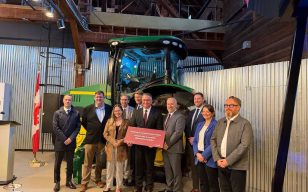
Roy Farrer of Raptor Dynamics, at the Ottawa Valley Farm Show with an XAC agricultural drone.
Farmers are already illegally using drones to spray crops as they wait for the law to catch up to the technology
Nelson Zandbergen
Farmers Forum
OTTAWA — Another cropping season is about to begin, and Ontario farmers still can’t legally deploy drone technology against existing and emerging pest threats like tar spot, the damaging fungus that continues to spread into — and threaten — more corn acres each year.
“It’s certainly an exciting space, but regulators should catch up sooner rather than later,” observed Roy Farrer, founder of Raptor Dynamic, an agricultural drone supplier in Calgary. His company carries a line of farm-purpose drones — the biggest in the industry — produced by XAG in China, a brand that exclusively makes drones for ag.
Farrer’s booth at the Ottawa Valley Farm Show featured a $43,000 unit capable of carrying a 65 kg payload. Currently in Canada, such a machine can only be used to broadcast seed or fertilizer on the farm — not the herbicides, fungicides and insecticides that are key to agriculture. The only pesticides permitted to date have no use in agriculture: mosquito larvicides and a tree defoliant used by hydro crews.
The regulatory regime in Canada still insists on separately licensing each agricultural pesticide for drone use even when already approved for conventional aerial spraying. The United States automatically allows drones to apply pesticides in that circumstance. In other words, in Canada you can use a chopper but not a drone to spray fungicide but it has been legal to use either south of the border for the better part of a decade.
Exactly when Canada might similarly cut the red tape “is a bit of a black box,” Farrer said.



In the meantime, a well-timed fungicide application can mean a 20-bushel-per-acre yield bump in a tar-spot field, he pointed out, adding he “couldn’t blame” farmers who turn to a drone to illegally protect their crop when there’s no other option.
Farmers Forum has previously spoken to a Southwestern Ontario drone owner who sprayed fungicide on an estimated 6,000 acres last year.
Farrer suggested the practice will become commonplace. He predicted that all in-field crop spraying will be drone-applied within five to seven years. “There’s no compacting of the soil, there’s no crop disturbance, and the price-point is accessible,” he said.
That would be a fairly rapid change from today. The market is currently in the “early adopter” or “enthusiast” phase with only about 2.5 % of farmers making use of the technology, he said.
“There’s still a place for tractors,” noted Keanan Stone of ValleyBio, a Cobden seed-crop farm that offers drone-broadcasted seeding services to clients. Stone added that row-planting will always be the job of tractors, “and drones can’t harvest a crop.”
But drones “have their place,” she said. “They’re going to become more of a common tool for farming.”