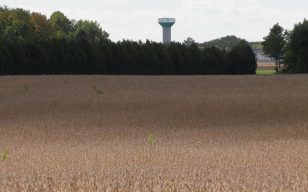
Hundreds protest the proposed Alto high-speed train line at Rigaud, Quebec, on Sept. 19.
Nelson Zandbergen
Farmers Forum
OTTAWA — A recently leaked federal document estimates that the Carney government’s Alto high-speed rail project will cost $150 billion to construct and operate over 40 years, although even this is an underestimate, according to Professor Ian Lee of Carleton University’s Sprott School of Business.
The whopping $150 billion figure, first reported by the Globe and Mail at the end of August, offers a more complete financial projection of the bullet train’s actual lifecycle cost to taxpayers. It goes beyond the regularly touted $60 billion to $90 billion estimate for just the capital construction of the 1,000-km line that is supposed to link Toronto to Quebec City. The internal briefing document prepared for Alto’s CEO pegs construction more precisely at $83.5 billion but adds in the cost of acquiring the trains (up to $2.2 billion) and 40 years of operations and maintenance (up to $67 billion).
While he was happy to see the updated Alto estimate come to light, Professor Lee pointed to California’s troubled 800-km bullet train as still a better gauge of the cost. That one is projected at $135 billion USD, or $200 billion CAD, for construction alone.
“And yet we have Alto saying they’re going to build a railroad 200 kilometres longer for about two-thirds less,” scoffed Lee, who grew up on a Lanark County farm. “Well, that’s just nonsense because we know that our cost structure in Canada is not 75 % below the Americans. In fact, the cost structure is quite similar, you know, wages and technologies and steel.”





Lee reserved his harshest critiques for Alto’s underlying ridership projections, which assume that millions of passengers will abandon their cars or flights to take the train. Proponents have suggested Alto will carry 71 % of all travellers in the region served.
“Which is beyond preposterous because no country in the world, including Japan, has even got to 30 %,” Lee observed, noting Japan’s rail ridership at 25 %, Europe at 7 %, and China at 3 to 4 %. “They cannot point to any country in the entire world that is even remotely close to 70 %.”
Even in rail-loving Europe, 75 % of travellers make their trips by car, he said, belying the stereotype of progressive, green Europeans “not strapped to the automobile like us bad North Americans.”
The rise of autonomous cars will ultimately “kill passenger rail” and leave Alto a “white elephant,” he predicted.
He also rejected the premise of a Toronto to Quebec City connection. Half of the working population in Quebec City is employed by the province and would have little call to go elsewhere for their jobs, according to Lee. “The idea that they’re sending a third or half of their workforce down to Toronto every day is just preposterous, absolute nonsense on stilts.”
The criticism comes as affected farming communities continue to push back against Alto. Farmers recently rallied in Rigaud, Quebec, against the first planned segment of the rail line. A reported 65 tractors paraded to a local dairy farm amid concerns about property expropriation, loss of prime agricultural land and the disruption of having the fenced-in rail line divide their communities.