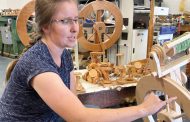
Ross Toebes is a herdsman and wife, Nicole, has her own line of farm attire. Mudeas Workwear is known for its overalls.
Nelson Zandbergen
Farmers Forum
JERSEYVILLE — Ross Toebes, 31, admits he just about tore the steering wheel off his Toyota when the radio blared an alleged impending shortage of 30,000 farmers in Canada, as claimed in a recent Royal Bank of Canada report that’s received a lot of media attention.
For years now, the experienced herdsman and his 27-year-old wife, Nicole, have been striving to buy their own farm. But the process of joining the ranks of Canada’s farmer owner-operators has been more akin to getting into an exclusive club surrounded by gatekeepers, not a vocation with a desperate need of new blood.
But they’re getting there, despite the many obstacles. To finally own their own farm, the couple and their three young children will leave Ontario to achieve their dream. They’re heading east.
They are very close to finalizing the purchase of a modest Prince Edward Island dairy farm after concluding that Ontario farms — serious ones that could actually support a family — are simply out of reach. Their offer to buy in PEI, conditional on financing, was accepted on Feb. 15. They’re now working toward a mid-June closing date after finding — on their third try — a financial institution “willing to do everything in their power to make it happen,” Toebes said, adding the farm seller has also been supportive.





In addition to financing from the helpful credit union, the arrangement involves a private lender as well as net proceeds from the planned sale of the couple’s current 2-acre property in rural Jerseyville, west of Hamilton. They were fortunate to buy before the pandemic and the surge in real estate prices.
The PEI operation, located just west of Charlottetown, will cost “in the mid $2-million” range, Toebes told Farmers Forum. He estimated that a similar farm in Ontario would cost more than $4-million.
Their purchase gets them $500,000 of dairy quota, a milking herd of 20 Holsteins in a tie-stall barn with attached bedding-pack housing, and a nice farmhouse overlooking the coast of Northumberland Strait. It also includes 500 acres of cropland — 200 owned plus 300 leased at $60 per acre annually. “The leased land is one-10th of what you pay to rent land in southern Ontario,” he noted.
Cash-cropping will be integral to the operation because the dairy herd is small. The land can support the typical corn, soybean and wheat commodity crops that he’s accustomed to, but at a yield about 70 % to 80 % of the Ontario norm.
Both he and his wife have a passion for agriculture, and “we’re looking forward to putting our own touches on things” at the PEI farm, said Toebes, who has worked as a herdsman at Loewith and Sons Dairy Farms, west of Hamilton, for the last six years.
He’s wanted to be a farmer since his youth, when he visited his uncle’s farm on weekends and in the summer. “To them, it wasn’t work, it was just play. So, seeing that and the opportunity to be a plumber, electrician, herdsman, engineer and a carpenter all before breakfast, I was hooked,” said Toebes, who graduated in 2012 with an agriculture diploma from the University of Guelph’s Kemptville Campus.
Most of his college graduating class of 50 people had a home farm to go back to, while Toebes was among five or six graduates unconnected to farms. Today, he reports being the only one of that small group still involved in agriculture as a full-time pursuit. Others went into trades or “a near-agricultural business.” One of those classmates became a hobby farmer, “but he’s principally a pipe-fitter.” Another became a firefighter. It doesn’t paint the picture of a province supporting new farmers.
His family’s impending move to the East Coast follows a series of attempts to truly break into the industry with a farm of their own.
Prior to arriving in Jerseyville and landing his current position, Toebes worked on two Ontario farms, both in need of a successor, on the understanding he might take over the business from the owners. But in both cases, things didn’t work out. “There were issues where my mindset and their mindset just weren’t meshing.”
They’ve kept their eyes peeled for available dairy farms in Ontario while he worked his dairy job and Nicole grew and sold vegetables off their own property. (She’s since dropped the market gardening effort as her farm-focused clothing line, Mudeas Workwear, keeps her busy, shipping daily to customers across the continent.)
Last year, they looked at buying one 80-cow, 150-acre dairy farm in southern Ontario, which was valued around $10-million. But with the amount of debt required “we would be just as poor 10 years into it as we were on day one,” he said. “We would have to get a private loan that would make most people sick.”
And yet, in Ontario, “a $10 million dairy farm is not an unreasonable size for two working adults to generate an income just for the two of them,” he pointed out.
They expanded their search beyond Ontario on realtor.com and first noticed the PEI farm about a year and a half ago, then fell in love with it.
The pursuit of a deal has also granted an education in the banking system. Toebes said that the first two banks he tried on the PEI purchase were looking for an uncomfortable amount of information from the involved private lender also contributing to the available funds, which was a turn-off. “I could see where it was going, and I was so frustrated pounding my head against the wall and thinking, ‘You’re thinking of every reason not to give me money.’”
By contrast, the manager of the provincial credit union now working with the couple has been enthusiastic and eager to see them succeed, he said.
The purchase process has taken longer than expected, he conceded. “There’s certainly many more checks and balances that have to be dealt with than we anticipated. The majority of that comes down to not having enough money in your pocket.”
He suggested there’s “no good answer” to the challenge of ushering new farmers like himself and his wife into the business because of the costs involved. But he said banks should do more than merely say they are there to “help” young farmers. “‘Help’ is more than just ‘business as usual,’” he said. “Help is: ‘We’re going to stick our neck out a little bit farther for you, to make it happen.”
Existing loan programs for young farmers, he added, “give you a part-time job — if that — and that’s for one person. For the practicality of it, if you’re going through all the hoops to get that loan, you want something that doesn’t still require you to go working off farm. So you have the resources to build and survive on the farm — not going and working for somebody else to pay off your loan.”
Meantime, he looks forward to enjoying the views of the ocean 500 feet from the PEI farmhouse, quipping that he “won’t get much work done” during that first week after the move.