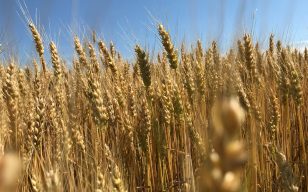
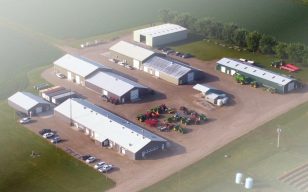
Kyle Como (above) and his father, Brian, farm near Winchester, and they say crops look poor and so do prices.
Nelson Zandbergen
Farmers Forum
EASTERN ONTARIO — Weeks of provincial drought combined with low commodity prices has evoked a double whammy of malaise for Ontario farmers.
Particularly in parts of Eastern Ontario, producers braced for yield losses that appeared to be baked in by mid-August, whatever rain might arrive after that. The expected yield damage stood in stark contrast with the bulk of the continent. While Ontario drew the weather short straw this year, the USDA was projecting bumper corn and soybean crops south of the border, further depressing global prices.
Growing crops since 1970, cashcropper and equipment seller Brian Como was philosophical. “We’ve had a lot of good years behind us. We’ve had good prices and good yields,” he said in mid-August, suggesting it’s back to “reality prices” this year. “You’ve got to take the good with the bad.”
The bad news this year includes a poor yield outlook due to the lack of rain, conceded Como, who grows 900 acres of corn of soybeans around Winchester. “It’s not looking good, and you just can’t reverse it,” he said, anticipating a “pretty sad fall” without significant rain.





“We’re losing bushels every day,” he said, adding that soybeans were being particularly hard hit by dry conditions extending into August because of their shallow roots. “Beans are made in August,” he pointed out.
Como also highlighted the broader negative economic impact of a poor crop year alongside lower prices.
As a used equipment dealer, he reported declining sales as farmers opt to repair their existing machinery rather than buy newer equipment in harder times. “Very few people actually need a new tractor or a newer tractor,” he said, adding that this frugality affects equipment dealers, truck sellers, and even furniture stores and the entire local economy.
Despite the grim outlook, Como still saw a chance for “average to good” yields in some areas — depending on the arrival of rain — though “the bumpers are off the table for the most part.”
The latest Agriculture and Agri-Food Canada climate maps indicate that broad swaths of the province’s agricultural areas — especially in the wider Eastern Ontario area — are either abnormally dry or in a moderate drought. Related online mapping tied to the North American Drought Monitor (plantmaps.com) calculates 45 % of Ontario under drought conditions.

Agriculture and Agri-Food Canada’s Sept. 1 map showing the percentage of average precipitation received in the previous 60 days. Eastern Ontario is immersed in yellow (indicating abnormally dry conditions or between 60 and 85% of average rainfall) and light brown (indicating moderate drought or between 40 and 60% of average rainfall.)
Colbourne-area crop farmer Larry Hutchinson, also manager of the local TCO Agromart outlet, underscored the mental and financial stress of the season. “It’s tough to watch your fields dry out and know the market’s against you, too,” Hutchinson said.
Hutchinson reported that his own corn and soybean yields were shaping up to be “way down” and unlikely to recover even with late rains. He noted that the drought’s timing was particularly damaging during critical growth stages, leaving crops “stunted and struggling” in a broad region between Cobourg and Kingston.
“There are some areas where you can tell the corn is not going to mature. You won’t even see them cut for silage,” he said.
But like Como, Hutchinson also emphasized the importance of resilience, asserting, “You’ve got to keep going, no matter how bad it gets.”
Campbellford cashcropper and elevator operator Peter Archer described the situation in his region as “bleak” and acknowledged the psychological burden on farmers anticipating the “double hit” of low yield and prices.
“I think we’ve got some guys that are that are extremely, extremely stressed about this, some younger producers,” Archer said, recalling a conversation with one individual “just stressed beyond his coping point.”
He added, “It’s a huge issue, and not a good situation. Anybody heavily leveraged in this situation who was counting on a crop this fall is under an absolutely enormous amount of stress. “This has gotten to be an expensive game to play. It just takes a massive amount of cash flow to get these crops planted, to keep this machinery running, to replace this machinery. I think that has amplified the whole stress factor.”
The stress can be acute for farmers who have forward-contracted on crops they won’t be able to fulfill this fall. But Archer noted that these contracts can be a form of equity, and the farmer has more options than simply buying grain to make up their harvest shortfall. Instead, they can roll their contract into the 2026 crop year without necessarily incurring a direct out-of-pocket cash expense. Archer recalled helping out a farmer in this circumstance who suffered a crop disaster a few years ago. The man couldn’t sleep for a month, wondering how he would fill his contract, until he called Archer who arranged a move of the contract to the following year.
“You accept a price that you can stomach on a small percentage of next year’s crop, to get you out of a jam for this fall,” he explained. “He was like, ‘Oh my God, I don’t know how you can do that.’ Well, that’s kind of my job to figure that out,” Archer said. “I have a knack at trading commodities. So I try to keep my customers in business the best I can, and there’s more than one way to skin a cat in this business.”
Athens-area market gardener Charles Summers says it seems to be worse from Prince Edward County to Peterborough. “The corn is two feet tall and just cooked,” he said. “I’ve never seen anything like it. I’m careful around the house. I worried about things burning.”
He added that what farmers need is two inches of rain.
Simcoe County crop farmer and grain merchandiser Steve Kell said that farmers didn’t forward-contract in greater numbers this year, as their thinking is still influenced by a long period of continually rising crop prices between 2008 and 2023. Those that did forward contact “aren’t feeling the full sting” of lower prices, Kell said, though he agreed that filling those contracts could pose a problem this fall.
Many farmers were hoping that last year’s decline in prices was an outlier and that 2025 would see a return to the exceptional prices seen between 2021 and 2023. In fact, that recent period now appears to be the outlier, according to Kell.
That reality, combined with this year’s yield hit, is especially disheartening for Ontario growers, he said. “Supply and demand should tell you that if it’s a small crop, it should be worth more, but those two things aren’t lining up, so it’s a pretty discouraging time.”
Kell noted that Ontario farmers have seen tight markets before and for extended periods of time. Prices were “terrible” between 1990 and 2002, he pointed out. Corn futures were slightly above USD $2 per bushel in 1998, he recalled. Currently, they’re around USD $4 per bushel for delivery this December. Adjusted for inflation and currency fluctuation, today’s corn price is about the same as it was in 1998.