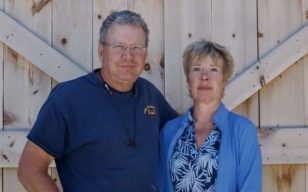
Sandra Eedy says a succession plan benefits the entire family and can ease parents into a less hectic role.
Don’t die without a plan for the farm
Farm wife recounts how husband’s death without a succession plan added to her burdens
Nelson Zandbergen
Farmers Forum
SEAFORTH — Sandra Eedy believes her husband of 38 years might still be alive today if only he had been willing to take part in farm succession planning.




Beyond logically planning for the farm’s future, Eedy says the process should have helped to ease Robert Eedy into retirement after he suffered a stroke at age 63 almost five years ago. But the hard-working cash cropper would have none of it, and his widow sadly sees a direct line to the massive heart attack that ultimately took his life during this year’s planting.

Robert Eedy died this year amidst the stress of planting season.
The coronary event occurred as he drove a tractor and cultivator in a soybean field on May 19, ahead of their son, Dann, 37, with the planter. Sandra Eedy says her husband was clearly unwell, and she begged him not to head out that day. But he did anyway, slammed the tractor door, she says, and proceeded to cultivate 60 acres. Afterward, he had to be physically helped out of the cab and rushed to hospital by ambulance, arriving in clothes covered in the soil of the field where he collapsed. He died two days later.
It could have been different, according to Eedy. “All he had to do was look after himself, look after the diabetes, look after the heart, slow down, get rid of the stress because agriculture has a lot of stress,” she says ruefully, a mix of emotions evident in her voice.
Her husband was in “total denial” about his mortality as he got older, she says.
They took part in three meetings with “the very best” farm succession professionals after his stroke — from which he mostly recovered — but the sessions only made him angry.
“I think it was his pride of thinking he was ‘giving up,’” says Eedy, a longtime agricultural accounts manager with the YNCU credit union and active partner in the farm. “But you’re not giving up. You’re moving your operation forward.”
In the case of Eedy Farms, that should have meant putting a formal plan in place to bring their son, Dann, into an ownership stake at the 1,100-acre operation after his years of sweat equity. But even as late as March of this year, Eedy says that she and her husband could only argue about the idea. He was content leaving his 50 % share of the farm to her as laid out in his will. Any transition details to the next generation would be up to her to handle in his absence.
The grandmother of five recalls the argument, quipping that she almost stamped her foot through the kitchen floor in exasperation: “I said, why would you, as an older farmer, not want to know what was going to happen to your land if something were to happen to you? And his exact response to me was, ‘I don’t care, I won’t be here.’”
He “pulled the reins in and said, no, I’m going to hang onto it. You can have it when I’m done,” she says, speaking figuratively.
“It didn’t make a lot of sense to me.”
Eedy told her husband that she intended to give their son his stake in the farm if he predeceased her, and he didn’t challenge it. A few months later, Robert Eedy seemed to accept this reality when he chatted with Dann the night before he died in the hospital and provided instructions on marketing crops they still have in storage and told him to “look after things,” she says.
Sandra believes her husband supported continuing the farm’s legacy through farm succession. “His pride got in the way.”
Now she has the task of handling her husband’s estate, with decisions around farm transition residing exclusively in her hands — decisions that would have been ideally shared with a living spouse. She concedes the situation is eased by her experience in the banking and business sectors.
Her advice to older male farmers is to consider the impact on their wives if they don’t put their affairs in order. “Don’t do to your wife what my husband did to me and refuse to make a succession plan. Don’t do that.”
She encourages farm wives to remain informed about what’s happening in their farm operations, its finances and its corporate structure, in preparation for the loss of a spouse.
The unexpected death of her husband also has her thinking about the fleeting nature of life. Her husband’s father and younger brother both died of heart disease at age 63. It was only in January of this year that they buried his brother.
In 2012, their son Dann was nearly killed in an accidental manure-generated methane explosion at his former hog farm. They almost lost him twice as he recovered from his burns, Eedy says, adding she couldn’t imagine trying to deal with the aftermath of her husband’s death now without her son being there.
She’s also making provision for her daughter, who is not involved in the farm, and she intends to eventually withdraw from her own farm ownership role when the time is right.
“None of us is going to live forever, but we have to push on,” Eedy says. “And if that means the next generation is going to be part of that pushing on, then that’s what we do. We make sure the path is clear, and they have what they need to continue.”