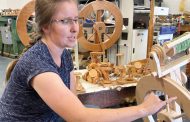
Don Metheral makes his living as a sheep shearer and has done so his entire life, travelling across Ontario. (Charles Summers photo)
Cut from a different cloth
A life dedicated to sheep shearing — No money in the wool but the sheep still need a haircut
Charles Summers
Farmers Forum
Clothes make the man, they say, and while we ought to judge people by the content of their character, the way we present ourselves says a lot about our person and how we see the world. It would seem that the soul at the grocery store we encounter midday: wearing pyjama pants, a polyester Star Wars shirt, croc sandals, five days of facial hair and fifty extra pounds considers neither that they were made in the image of God, nor that the rest of us have to look at them.
It might seem strange to dwell on fashion in a farming publication, but it’s important to consider that as much as farmers feed the world, they have also traditionally clothed it: in cotton, wool, linen (flax), leather and even silk. Today, clothing has increasingly become the domain of the oilman, where we evermore shroud ourselves in petroleum products and even boast of wearing “fleece” made from recycled pop bottles.
Real fleece, of course, comes from the backs of sheep. No one is more familiar with this than Don Metheral, of Collingwood. Don makes his living as a sheep shearer and has done so his entire life. He’s pretty darn good at it, with over 250 clients across the province. How good? I wouldn’t know where to start if you slid me a ewe and a set of shears, but Don has literally won the world championship in Blindfolded Shearing (yes, sheep shearing is a competitive sport on top of being an essential industry). Don knows sheep better than the back of his hand, but he paradoxically now offers his services to Ontario lamb farmers at a loss to the grower: that’s right, wool — one of nature’s most magnificent materials — is now essentially worthless.





Sheep farmers have to shear their flocks as a matter of hygiene, and Don provides an expert service that growers rely on for his roving annual care. But it’s unlikely it will grace any of our wardrobes.
The carding, spinning and weaving of wool was a historic industry here in Ontario, but like so many things, can either be done cheaper somewhere else, or has been entirely supplanted by new materials and technology. It’s a similar story to leather. While once there were tanneries in every small town and village, today, when you or I have a beef killed, we’ll probably have to pay a disposal fee for the hide: there is simply no market left for it in this part of the world.
Don is a living, breathing example of extreme expertise. Being really, really good at something with your hands and body: taking pride in it and making it your vocation is not really fashionable anymore. Don is a throwback to the type of people that built this country. And you would notice if you look at photographs from 100 years ago, that when the people who built this country got dressed in the morning, they took things seriously. Going out in public with poor grooming, scuffed shoes or without a clean shave was an affront to the entire undertaking of carving a nation from the wilderness: building civilization from scratch is serious business. Now that it’s been accomplished, many of us choose to dress like we are on vacation.
Don doesn’t really do vacations. His idea of a good time is to travel back to New Zealand, where he acquired his expertise in the craft, to compete in the Golden Shears: the World Series of shearing.
He’s been representing Canada there for decades. Back home, he figures he works well over 300 days per year, and makes a handsome living at it.
As I observe Don toil, I marvel at the raw athleticism on display. Manhandling fully grown ewes well over 100 lbs, they’re putty in his hands, and he gently works them over, subtly manipulating the animals — largely with his feet. He wears special double layered wool pants and moccasins to protect his skin and ease the work. Every stroke of the shears is met with a deft movement of his legs as the animal quietly rolls and glides to his command. In less than a minute, a perfect fleece lies on the barn floor.
As someone who has spent much of the last twenty years bent over in a vegetable garden, I can only imagine the toll this must take on his body. I feel pain just looking at him going hard after nine hours of shearing, but I don’t hear even a grunt from Don. At 54, it still doesn’t phase him a bit. “The only time I get sore is when I don’t work.” Use it or lose it! His passion for the craft is something he shares with his siblings, who also shear. His brother finally hung up his shears at 70 years young.
Clothing is significant because it is a visual representation of culture. It signifies all sorts of values and expectations. Politics is largely downstream from culture, and so because we have largely given up on presenting a serious visage in our day to day lives, our politics reflects this: it’s mainly just bickering and back biting instead of presenting any sort of vision of where we want our world to go. We’ve hung our nice clothes in the closet, and what we have left is nonsense.
The world of competitive sheep shearing is a refreshing example of pride in workmanship. It might appear simple to an outsider, but there are layers and layers of talent that can be applied. This is how you turn what would seem to be a thankless, brutal, repetitive occupation into a craft that you can be proud of and share. After all, we all have a part to play in making our world work. The clothes we used to wear reflected the land and people around us. It was a part of our culture. Farmers produced the materials, workers and millwrights made the factories hum, and how we dressed represented the net product of countless lives within our communities.
I grew up in Belleville, during the last gasps of the city’s industrial era. Deacon Brothers was still in operation when I was a child, and a dear friend recently gave me a lovely scratchy wool garment that was manufactured in my hometown during the 1980s: a plaid hunting jacket (this was when hunters dressed relatively normal, and not like they were behind enemy lines in Vietnam). For some reason, over the past 20 years or so, this item of clothing has taken a new life in the form of some sort of integrated “hoodie”, where it’s meant to look like you’re wearing a sweatshirt under the jacket, but they just sort of sewed parts of them together with a zipper in the front. They’re not made of wool anymore, and they’re made in China. It’s fake clothing for a fake world.
Every year brings a new crop of wool. Don will be there, and busy training the next generation of shearers. He’ll send the best of them to New Zealand to learn at the side of other masters, where Merino sheep represent the last of the functional wool industry. As much as Don is handing down a specific trade, he’s passing on a perishing mindset of hard work and community. When I ask him what he likes most about his trade: “It’s staying with the families,” (shearers bunk with the farmers they work for as they travel). “I’m watching kids who folded wool for me have children of their own.”
Don is well aware that he is keeping a fire alive to pass onto the next generation. We all share the same opportunity. As we look at ourselves in the mirror in the morning, the question to ask is, “Am I serious?”

Sheep after being sheared at Black Kreek Ranch, owned by Brad and Karen Davis, at Lansdowne, west of Brockville.