Nelson Zandbergen
Farmers Forum
STRATFORD — A recently ousted farm leader is sounding the alarm over Ontario’s upcoming update to the Environmental Farm Plan (EFP) because of added climate change ideology in the document required by many Ontario farms.
John Van Dyk, a Stratford-area dairy farmer, says he learned of the EFP’s new climate-focused chapters while sitting as a board member with the Christian Farmers Federation of Ontario (CFFO) — the second largest of Ontario’s three accredited farm organizations. He says he was fired from the board in February after kicking up a fuss over the changes, which the province is expected to announce sometime later this year.

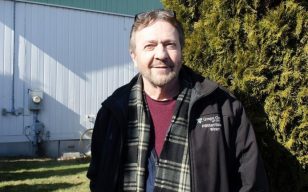
John Van Dyk.
Although touted as voluntary, most Ontario farms keep an EFP on file — prepared with the help of a standardized workbook — as a precondition to qualify for many government funding programs and grants. Having an EFP is also a flat-out mandated part of dairy farmers’ ProAction certification and crop farmers’ participation in AgriStability. The EFP was last updated in 2013. Updates are led by the Ministry of Agriculture, Food and Agribusiness (OMAFA), with review by the CFFO, the Ontario Federation of Agriculture (OFA), and the Ontario Soil & Crop Improvement Association (OSCIA), which administers and delivers the program.
Unaware that a new fifth edition EFP workbook was being developed by OMAFA since the summer of 2024, Van Dyk was “shocked” at the draft changes — including new “climate adaptation” and “climate mitigation” modules — when they were presented to the CFFO board in November. “I was opposed to it, and so were a couple of others. And then there was one more meeting that year, and we were provided a few more details, and we were still opposed.




“Then I didn’t hear anything until late January, and all of a sudden they (the board) were like, yeah, we’re going to sign it, and they signed it.”
The board approved the climate change additions on Jan. 30 in a 5-1 vote without telling their members knowing that most of them would have opposed it, Van Dyk said. He points to a 2023 survey of CFFO members that found more than 50 % opposed to the climate change narrative. The day before the vote, he fired off an email to all CFFO district leaders informing them of what was happening and expressing his concerns. The move roiled the board, which voted to remove him on Feb. 5 — less than a year after he was elected as a district representative.
“They used the excuse that I was too harsh,” explained Van Dyk, who admitted to describing the president as “two faced” during the Feb. 5 session. “I didn’t use any bad language, but I had a lot of hard questions,” he said, noting that the president voted for the climate change additions even though “during the whole year he would act like he was against the climate narrative.”
Van Dyk says the new EFP sections are premised around measuring and “benchmarking” a farm’s CO2, methane and nitrogen emissions. He says his fellow board members were persuaded that there’s no harm in farms tracking that data, though he begs to differ. “That’s going along with the narrative, that you agree these three gases are a problem. Otherwise, why do you need to track all that?”
The requirements will only get worse, he predicted, especially as the board was informed that officials hope to update the EFP more frequently in future. He added that no one spoke up in favour of the new climate-change additions when the CFFO hosted an online ‘grassroots’ meeting with the membership in March, which included a sneak peek of a few draft slides from the upcoming update.
“All the farmers that reacted to the slides were against it,” confirmed Oxford County dairy producer Reinald Treur, who attended the session.
Truer pointed out that the EFP was intended to be a private self-assessment tool for farmers. But with the inclusion of emissions measurement, he was concerned about where it was heading, including the potential collection of data to make even more rules for farmers. “So eventually, they’re going to use our own self-evaluation tool … to make us do stuff, to make us comply. That net zero ideology, I don’t buy it.”
Truer added that he favours conventional stewardship efforts, like recycling and reducing food waste. But striving for net zero “just goes too far,” he said.
He was also concerned with the apparent secrecy around the EFP update and suggested that bureaucrats shouldn’t be the ones in control. “Why aren’t farmers involved in a program that is all about them? They should have input. Why should bureaucrats look at that? They don’t even farm themselves. I mean, it doesn’t make sense, right?”
Grey County dairy producer Jan Antuma echoed that criticism. “The larger concern is that the EFP was a farm organization-led program, and now the government is taking control … and pushing for changes and how they can utilize it for their own purposes,” said Antuma, who also took part in the grassroots session. He agreed that there was concern expressed at the meeting about OMAFA “muscling in” on the EFP.
The government in the future “wants to maybe use this program for carbon capture, like a carbon-credit type of program” and as “scorecard” on farm emissions, he speculated. “That’s the worry among farmers.”
Ontario Soil and Crop Improvement Association field services manager Melanie Hunter explained that the EFP was due for a refresh after 12 years since the last update. From a practical standpoint, there are pages in the current workbook referring to legislation that has changed, she pointed out.
The new EFP does have “an increased focus on things like species at risk, biodiversity and climate change that weren’t addressed” in the last edition, Hunter acknowledged.
“This project was led at the direction of OMAFA,” she said, adding that the other involved farm organizations “had the opportunity to review.”
The climate change aspect, specifically, “might be coming from the government,” OSCIA president Eleanor Renaud said. The Jasper-area beef farmer said she believed the new EFP might be released in August or September.
The CFFO declined to comment on Van Dyk’s departure from the board of the Christian Farmers’ Federation of Ontario.
In the meantime, Van Dyk says he is spearheading the creation of a new, national farm organization — the Farmers of Canada — that is expressly opposed to the climate change agenda.
New group — Farmers of Canada — to fight climate change policies