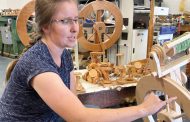
Jenny Carnaghan is Ontario’s 2024 women’s excellence award winner in agriculture.
Nelson Zandbergen
Farmers Forum
BLACKSTOCK — Lamb producer Jenny Carnaghan says that raising lamb for the Ontario market offers a great opportunity for people looking to get into the industry.
“It’s not a cookie cutter industry anymore,” says Carnaghan, who farms near Blackstock with her husband, Luke, and their three teenaged children. “There are so many options, and it can fit into anybody’s farm lifestyle. If you have off-farm jobs and still want to have sheep in a big way, you can do it,” adds Carnaghan, first-place recipient of Ontario’s 2024 women’s excellence award in agriculture. “You just have to adapt the operating system to fit your style.”
She and her husband both grew up on sheep farms and produce about 2,500 lambs for market from a flock of 1,200 ewes at Carncroft Farms. They started with only 40 or 50 ewes and a similar number of beef cattle in 2003, after Luke took over the operation from his grandparents. They still run a 50-head beef cow-calf operation but gradually expanded their sheep output.
“We’ve been very fortunate to be in the sheep industry,” she said, contrasting the sector’s relative stability to the challenges of raising beef over the same period. “Generally, we’re selling our beef calves when they come off the cows in the fall, but some years that doesn’t work. So you’re having to navigate when’s the best time to market your animals. But with the sheep, we haven’t had that issue. It’s been consistent.”




She also points to her farm’s longtime participation in the Trillium lamb producer group as a factor in her family’s success. Trillium acts as a collective single-order desk used by abattoir operators to source lamb from 25 participating farmers working together to market their animals. Carnaghan is a founding member of the group, which started in 2013, and her involvement was among the reasons for the provincial award that she collected at the Royal Winter Fair in Toronto. She was also recognized for her community work, volunteering with education programs put on by Durham Farm Connections. More recently, she became a 4-H leader in Durham East.
In their most recent expansion, Carncroft Farms erected a new lambing barn two years ago. Lambings occur three times a year in an accelerated cycle. Resembling a modern dairy barn with side turkey curtains, the structure has capacity for 500 ewes. A similar barn at their neighbour’s farm serves as a feeder barn to raise the lambs into two market weight categories. They also have an older loafing barn.
Lambing and raising sheep on pasture is a challenge because of predator pressure, she said. They tried it but switched to a confined system to eliminate predator issues.
They grow their own feed but employ a contractor to harvest and pack their silage and haylage into ag bags. However, they do have their own equipment and tractors for other tasks, including a tow-behind TMR unit to dispense the feed ration in the barn.