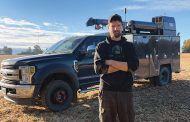
John Graff, Saskatchewan farmer and National Citizens Inquiry board director.
BIG DATA IS COMING
Tsunami of artificial intelligence and data centres threatens agriculture
Nelson Zandbergen
Farmers Forum
OTTAWA — As if Canadian agriculture isn’t beleaguered enough, a new threat looms on the horizon: an explosive expansion in data centres and related artificial intelligence (AI) infrastructure.
Witnesses voiced grave concerns over the escalating strain these technological hubs place on the power grid, land and water resources, while testifying on the question, “Is Agriculture Safe?”





The National Citizens Inquiry (NCI) conducted the privately organized hearings in High River, Alberta, over three days in August.
Saskatchewan farmer and NCI board director John Graff highlighted the unprecedented electrical demands driven by processing centres dedicated to artificial intelligence. Graff warned that the sheer volume of power required to sustain AI infrastructure threatens to increase energy costs for rural communities and farms.
Just one AI data centre would consume the equivalent of nearly 11 % of Alberta’s current electricity output, according to Graff. The actual power demand of 13 data centres now proposed in that province, he added, would consume 140 % of Alberta’s current electricity generation.
“In other areas, they’re trying to let the grid supply them … and so everyone is worried about brownouts and shutdowns,” he said.
Graff acknowledged that Alberta is pushing instead for on-site, gas-fired generation at the involved data centres. Combined, those 13 sites would generate more power than is otherwise produced in all of Alberta. While that would take the pressure off the electrical grid, the trade-off would be higher natural gas prices for everyone, he argued, noting that just one AI data centre generating plant would consume more gas than every home, business and farm in the province. The entire fleet of 13 would use 20 times more. “So all the (gas) wells you see out there, we need 20 times as much,” observed Graff, who also reported on the deleterious effects of venting and flaring gas wells near farms.
The Royal Bank estimates that overall data centre energy demand in North America will roughly triple by 2030, with AI accounting for 70 % of that new growth. That means many more data centres popping up around the country, including rural Canada. In the U.S. the majority of planned AI data centres are slated to be built in rural areas, according to Pew Research, a departure from pre-AI data centres more commonly located in urban areas.
Rural Albertan and consultant Jasona Rondeau outlined the formidable task that landowners face when opposing proposed AI data centres.
“It is something that consumes people’s lives for a minimum of two years,” Rondeau said. “So the stress that landowners have to go through when these project developers approach them … is they don’t know what they’re up against, they don’t know the industry. They have full-time lives, full-time families. So they don’t have time to take a two-year correspondence course on how to save their land.”
Rondeau counted several solar projects “denied” through her advocacy. “Because they were all inappropriately sited on agricultural land.”
She testified that project developers use a defined playbook to “divide and conquer,” attempting to consult landowners one-on-one so they don’t compare notes. Pointing to a proposed data centre near Olds, Alberta, she warned that such facilities consume vast swathes of cultivated land and top-quality soil.
The pressure is also being felt in Ontario, where the province’s Independent Electricity System Operator (IESO) currently has connection requests exceeding 10,000 megawatts for proposed data centre capacity. That’s equivalent to about 100 AI data centres. Some municipalities, like Oakville, have imposed a freeze on new data centre development in response to the potential local impact.
Originally formed in 2022 to investigate the abuses of Canada’s Covid-19 pandemic responses, the citizen-led NCI more recently expanded its scope to examine Canada’s food supply and the risks to agriculture.