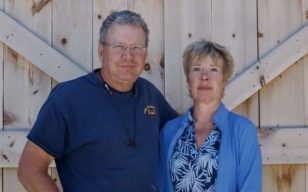
The name of the farm — Ferme des 4 Guindon — reflects the fourth generation of owners, Jenrené and Chantal Guindon, pictured, with sons Olivié, 17, Zavié, 16, and Marcandré, 14.
Nelson Zandbergen
Farmers Forum
HAMMOND — An Eastern Ontario dairy farming family will celebrate 100 years and four generations of dedication to milking cows on Nov. 15. And although the modest owners don’t like to dwell on the fact, this milestone is all the more heartening after they endured a traumatic storm that could have ended everything only three years ago.
The powerful ‘derecho’ wall-of-wind that blew across the province knocked down a concrete silo at Ferme des 4 Guindon Inc. in Hammond, smashing the dairy barn’s milkhouse and damaging part of the tie-stall barn’s roof. It was all over in just a couple of minutes. Moments before the destruction, owners Jenrené and Chantal Guindon and their three teenaged sons rushed into a machine shed across the farmyard and braced themselves against the door to keep it shut. They watched as the silo toppled in the violent wind.
“If I wouldn’t have closed that big door a minute before, the shed would have blown away like a parachute, and all five of us were in there,” said Jenrené, his eyes appearing distraught at the memory.
“It was like the movie Twister,” he recounted. The wind howled, debris flew through the air and his youngest son was last to sprint into the machine shed yelling, “I’m coming!”





“You just couldn’t believe it,” said Chantal, who works at the Ottawa Hospital when not handling the farm’s bookwork. “But that was one minute out of the hundred years,” she added. “A lot of things happen in 100 years.”
Still, the storm was “maybe one of the most eventful things” in the farm’s history, Jenrené conceded, leading a visitor on a tour of the spacious tie-stall barn that was repaired and expanded in the year after the calamity. No livestock were lost, but property damage was extensive, requiring the herd of 60 cows to be milked at another Hammond-area dairy farm, Hamlane Farm, owned by the Rijke family, until operations resumed at the Guindon farm in June 2023.

Jenrené Guindon prefers the “better individualized care” provided in a tie-stall barn.
Jenrené worked at the Rijke farm for that year, his first time as an employee. It gave him a taste of working in a free-stall-with-parlour barn and bunker-silo feed storage. The experience verified his preference for his existing tie-stall setup with upright silos.
“Free-stall is nice, but it’s not exactly what I thought it was,” he explained. “There can be hoof problems, and there’s competition between animals. He added that a cow is “more of a number than an individual” in a free-stall barn. By contrast, he prefers the “better individualized care” afforded in a tie-stall environment. There’s no need to ever find and fetch an animal, for medical care or whatever reason because the cow’s location is always known in a tie-stall, he said.
The tie-stall barn at the Guindon farm was already extensively updated in 2014 with high ceilings that eliminated the traditional hayloft at the time. The barn is bright and airy, with wide stalls and cattle oriented in a heads-out configuration with gutters on either side of the center alley.
A Rovibec feed-pushing robot pushes up feed that is prepared by a ValMetal auto ration.The unit is custom-painted red as a tribute to the farm’s loyalty to the Case-IH brand, a tradition that dates back to the days of Farmall.
Two new upright poured-concrete silos, each 20 feet wide and 100-feet tall store the haylage and silage. Not only did the family replace the 80-foot silo that fell down, they also replaced another one that survived the storm. A far cry from the construction standards of yesteryear, each silo was built onto 11 piles extending 150 feet down into the ground. “Engineers want what they want, and you want to follow,” he said.
The barn retains its rail-mounted DeLaval milking system, allowing the farmer to move from cow to cow without holding the weight of the milker. The milker units include electronic meters, providing the producer with as much computerized data as he might get in a parlour.
The recovery project included an expansion on the end of the barn, bringing the number of stalls to 72. The new section is a 50-by-65-foot addition onto the original 175-foot barn and includes 12 new milking stalls and one 12-by-50-foot sand-bedded calving area to meet new regulations. They milk 60 to 65 cows, a 10 to 15 % increase from pre-storm levels. Incorporated into the addition is a new and larger milk house, mechanical room, and an electrical room with standby generator.

The Valmetal feed-pushing robot is custom-painted red as a reflection of the farm’s long-standing preference for the Case-IH brand.
Insurance covered the family’s losses from the storm and the Guindons also invested additional money into the operation.
But for all the technology, he enthuses as much about his game-changing decision to hire a Guatemalan through the temporary foreign worker program six months ago. Now 29, the young man is treated like family. “This guy is like my other son,” the farmer said, praising the man’s “unbelievable work ethic.”
The employee, named Wilder, handles 10 tasks efficiently, often “with a smile and singing,” and never quits even 10 minutes early. “You’ll never see him stop.”
Jenrené and Chantal’s sons Olivié, 17, Zavié, 16 and Marcandré, 14, also work well in the barn, following in the footsteps of their father, grandfather (Gilles), late great-grandfather (René) and their late great-great grandfather (Arthur, who founded the farm in 1925). The couple, both graduates of Alfred College at the turn of the century, bought the farm from Jenrené’s parents in 2019.
The name of the farm — Ferme des 4 Guindon — reflects the four generations of owners, with the current crop of teenagers being the fifth.
In a numerical twist, each generation of second-born Guindon men raised at the farm came into the world 30 years apart. René was born 1919, followed by Gilles (1949), Jenrené (1979) and Zavié (2009).
The operation has had a purebred Holstein dairy herd since the 1950s. For many years, until supply management came along, the farm shipped its milk to a local cheese factory in Hammond. They grow 300 acres of crops.
The Nov. 15 open-barn event (1 to 4 p.m. at 141 Butler Rd., Hammond) was purposely timed to coincide with the farm’s century anniversary.
Jenrené thoroughly enjoys being a dairy farmer, with zero commute time to his job. He wouldn’t have it any other way. “I’m working at my own place, long hours, seven days a week, but I always have lunch and supper at home.”