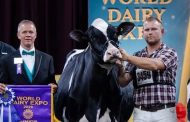
The Hoogerbrugge family was recently honoured with Holstein Canada’s 2025 Master Breeder distinction.
A “little different” strategy leads to big results for High Bridge Holsteins
Nelson Zandbergen
Farmers Forum
PARKHILL — In a dairy landscape dominated by black and white, Adrian and Jolanda Hoogerbrugge have found their niche by embracing the red. The founders of Highbridge Holsteins Ltd. were recently named among Holstein Canada’s 2025 Master Breeder recipients, a prestigious 16-year achievement that Adrian admits he hadn’t even heard of when he first arrived in Canada from the Netherlands in 2000.
Highbridge, shortened to H-Bridge for the farm’s official prefix, is the English translation of the family surname.
“There are so many good black and white breeders and we just want to be a little different, have something different,” explains Adrian Hoogerbrugge, who grew up on a farm with red and white Holsteins and carried that passion across the Atlantic. “That way it is a niche market. And if you’re disciplined enough to keep it red, I think you can catch quite a bit extra out of it.”




Nearly 1,200 Master Breeder shields have been handed out since 1930. Shields are awarded based on points for balanced breeding with high production, outstanding conformation, and great reproduction, health, and longevity. Earning a shield takes 16 years at minimum. Some long-established farms have received multiple shields over the years.
Only about 2 % of Holsteins on the ground in Canada are red and white. In the evolution of the Hoogerbrugge’s herd some black and whites contributed to the herd’s overall points. But it is so rare that a master breeder has a red-and-white-only herd that the Hoogerbrugges believe they are the first in Canada.
Red and whites are more common in the Netherlands, and Adrian saw an opportunity in Ontario to develop a high-performance red herd. The family’s move to Canada was driven by a lack of growth opportunities in the Netherlands due to tightening regulations, he said. After looking at options in France, they chose Canada and haven’t “regretted one single day.”
Starting with a group of 35 unregistered black and white cows at the Middlesex County farm south of Parkhill, the family slowly transitioned the herd through strategic buying, breeding and flushing of red animals. “Eventually you get there,” Adrian remarked. The herd became 100 % red and white in 2020.
They began with 35 production cows on a farm of bare land and sheds, an operation that has since grown into a three-farm family collective totalling 450 acres and a 110-head production herd milked with two robots on the home farm. Adrian and Jolanda are the founding Highbridge partners, and their sons Dennis and Frank have established their own farms nearby, though the families continue to coordinate their breeding programs.
While he admits that for years red and whites were seen as “good looking cows that didn’t milk,” he is proud to break that stereotype, saying, “Our cows do milk.” The individual average is 45 to 50 litres daily, or a collective 14,000 litres annually, with butterfat at 4.5 %.
“We want good, excellent cows — old cows that produce a lot of milk,” Adrian said of his breeding philosophy. He looks for cows with “good udders, good feet and legs,” and significant “dairy strength.”
The Master Breeder shield, which the couple will travel to Vancouver to collect in mid-April, is a byproduct of their focus on high-quality genetics. Highbridge has become a source for worldwide genetics, putting six or seven bulls into AI last year alone and selling embryos into Europe.
Adrian said the award was a “pleasant surprise” when announced earlier this year. “We always said we want to breed the cows we want to milk,” he observed. “If that results in a Master Breeder shield, that’s fantastic. But it’s on our own terms.”
The family has undergone its own recent transition. In January, youngest son Frank took over the home farm, while Adrian and Jolanda moved down the road and downsized to a smaller one-robot herd known as “Haskett Holsteins,” named after the road itself. But the goal remains the same: “We like to spend the time in the barn. That’s where our passion is,” he said.
Ontario herds captured 5 of the 21 shields awarded by Holstein Canada this year. All five are first-time recipients.
In addition to H-Bridge Holsteins, the Ontario group includes Birdolm Holsteins of Rockwood, Eastedge Holsteins of Springfield, Hiddenspring Holsteins of Elmira and Vonburg Holsteins of Woodstock.